Advertisements
Advertisements
प्रश्न
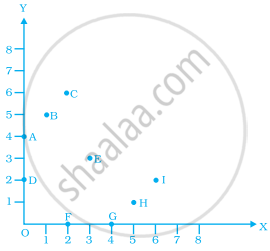
From the given graph, choose the letters that indicate the location of the points given below.
- (2, 0)
- (0, 4)
- (5, 1)
- (2, 6)
- (3, 3)
Advertisements
उत्तर
On observing the graph, we see that the point F is on X-axis, so its Y-coordinate will be zero.
Also, it is at a distance of 2 units from origin.
... The coordinates of F are (2, 0), similarly the coordinates of G are (4, 0).
H is at a distance of 5 units from Y-axis and 1 unit from X-axis.
... The coordinates of H are (5, 1).
D is at a distance of 6 units from Y-axis and 2 units from X-axis.
... The coordinates of D are (6, 2).
The point D and A are on Y-axis at distances of 2 units and 4 units respectively from the origin.
Hence, the coordinates of D and A are (0, 2) and (0, 4), respectively.
B is at a distance of 1 unit from Y-axis and 5 units from X-axis.
... The coordinates of B are (1, 5).
C is at a distance of 2 units from Y-axis and 6 units from X-axis.
... The coordinates of C are (2, 6).
E is at a distance of 3 units from Y-axis and X-axis both.
... The coordinates of E are (3, 3).
APPEARS IN
संबंधित प्रश्न
Draw the line passing through (2, 3) and (3, 2). Find the coordinates of the points at which this line meets the x-axis and y-axis.
Locate the points:
(1, 3), (2, 3), (3, 3), (4, 3)
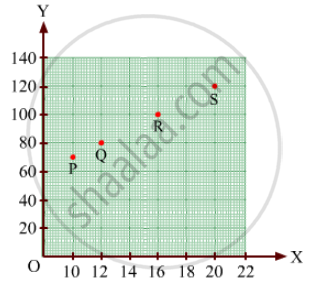
Find the coordinates of points P, Q, R and S in Fig. 27.8.
We need ______ coordinates for representing a point on the graph sheet.
For the point (5, 2), the distance from the x-axis is ______ units.
A point has 5 as its x–coordinate and 4 as its y–coordinate. Then the coordinates of the point are given by ______.
Write the x-coordinate (abscissa) of the given point.
(0, 5)
Locate the points P(3, 4), Q(1, 0), R(0, 4), S(4, 1) on a graph sheet and write the coordinates of the point of intersection of line segments PQ and RS.
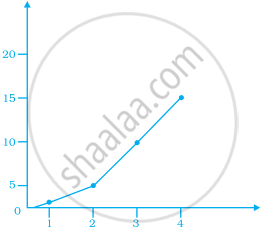
Observe the given graph carefully and complete the table given below.
| x | 1 | 2 | 3 | 4 | 5 |
| y |
The points on the graph below represent the height and weight of the donkey, dog, crocodile, and ostrich shown in the drawing.
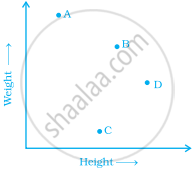
- What are the two variables represented in the graph?
- Which point represents each animals? Explain.
