Advertisements
Advertisements
प्रश्न
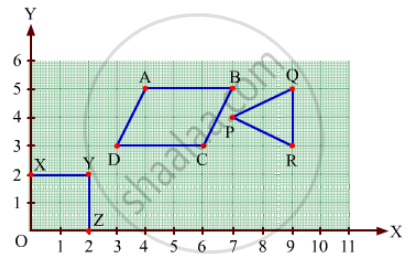
Write the coordinates of each of the vertices of each polygon in Fig. 27.9.
Advertisements
उत्तर
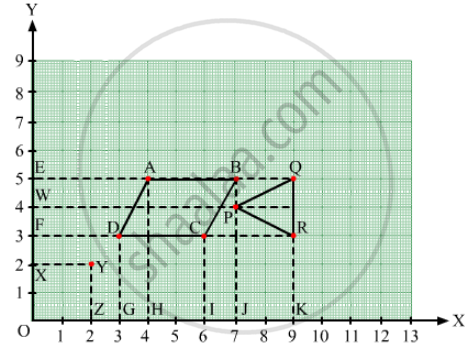
From the figure, we have:
In polygon OXYZ:
O lies on the origin and the coordinates of the origin are (0, 0). So, the coordinates of O are (0, 0).
X lies on the y-axis. So, the x-coordinate is 0. Hence, the coordinate of X is (0, 2).
Also, YX is equal to 2 units and YZ is equal to 2 units. So, the coordinates of vertex Y are (2, 2).
Z lies on the x-axis. So, the y-coordinate is 0. Hence, the coordinates of Z are (2, 0).
In polygon ABCD:
Draw perpendiculars DG, AH, CI and BJ from A, B, C and D on the x-axis.
Also, draw perpendiculars DF, AE, CF and BE from A, B, C and D on the y-axis.
Now, from the figure:
DF = 3 units and DG = 3 units
Therefore, the coordinates of D are (3, 3).
AE = 4 units and AH = 5 units
Therefore, the coordinates of A are (4, 5).
CF = 6 units and CI = 3 units
Therefore, the coordinates of C are (6, 3).
BE = 7 units and BJ = 5 units
Therefore, the coordinates of B are (7, 5).
In polygon PQR:
Draw perpendiculars PJ, QK and RK from P, Q and R on the x-axis.
Also, draw perpendiculars PW, QE and RF from P, Q and R on the y-axis.
Now, from the figure:
PW = 7 units and PJ = 4 units
Therefore, the coordinates of P are (7, 4).
QE = 9 units and QK = 5 units
Therefore, the coordinates of Q are (9, 5).
RF = 9 units and RK = 3 units
Therefore, the coordinates of R are (9, 3).
संबंधित प्रश्न
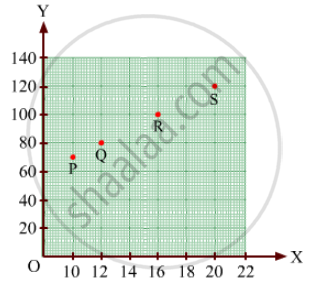
Find the coordinates of points P, Q, R and S in Fig. 27.8.
The following table shows the amount of rice grown by a farmer in different years:
| Years: | 2000 | 2001 | 2002 | 2003 | 2004 | 2005 | 2006 |
| Rice grown (in quintals): | 200 | 180 | 240 | 260 | 250 | 200 | 270 |
Plot a graph to illustrate this information.
We need ______ coordinates for representing a point on the graph sheet.
A point has 5 as its x–coordinate and 4 as its y–coordinate. Then the coordinates of the point are given by ______.
The distance of any point from the x-axis is called the x-coordinate.
The points (3, 5) and (5, 3) represent the same point.
Match the coordinates given in Column A with the items mentioned in Column B.
| Column A | Column B |
| (1) (0, 5) | (a) y coordinate is 2 × x - coordinate + 1. |
| (2) (2, 3) | (b) Coordinates of origin. |
| (3) (4, 8) | (c) Only y–coordinate is zero. |
| (4) (3, 7) | (d) The distance from x-axis is 5. |
| (5) (0, 0) | (e) y coordinate is double of x-coordinate. |
| (6) (5, 0) | (f) The distance from y-axis is 2. |
Match the ordinates of the points given in Column A with the items mentioned in Column B.
| Column A | Column B |
| (a) (7, 0) | (i) The ordinate is double the abscissa. |
| (b) (11, 11) | (ii) The ordinate is zero. |
| (c) (4, 8) | (iii) The ordinate is equal to the abscissa. |
| (d) (6, 2) | (iv) The abscissa is double the ordinate. |
| (e) (0, 9) | (v) The abscissa is triple the ordinate. |
| (f) (6, 3) | (vi) The abscissa is zero. |
The points on the graph below represent the height and weight of the donkey, dog, crocodile, and ostrich shown in the drawing.
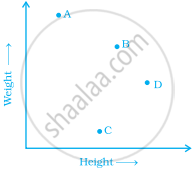
- What are the two variables represented in the graph?
- Which point represents each animals? Explain.
