Advertisements
Advertisements
प्रश्न
The distance of any point from the x-axis is called the x-coordinate.
पर्याय
True
False
Advertisements
उत्तर
This statement is False.
Explanation:
The distance of any point from x-axis is called its y-coordinate and the distance of a point from y-axis is called its x-coordinate.
APPEARS IN
संबंधित प्रश्न
Draw the line passing through (2, 3) and (3, 2). Find the coordinates of the points at which this line meets the x-axis and y-axis.
Locate the points:
(2, 1), (2, 2), (2, 3), (2, 4)
The following table shows the amount of rice grown by a farmer in different years:
| Years: | 2000 | 2001 | 2002 | 2003 | 2004 | 2005 | 2006 |
| Rice grown (in quintals): | 200 | 180 | 240 | 260 | 250 | 200 | 270 |
Plot a graph to illustrate this information.
The process of fixing a point with the help of the coordinates is known as ______ of the point.
For the point (5, 2), the distance from the x-axis is ______ units.
In the coordinates of a point, the second number denotes the ______.
The ordinate of a point is its distance from the y-axis.
Write the x-coordinate (abscissa) of the given point.
(7, 3)
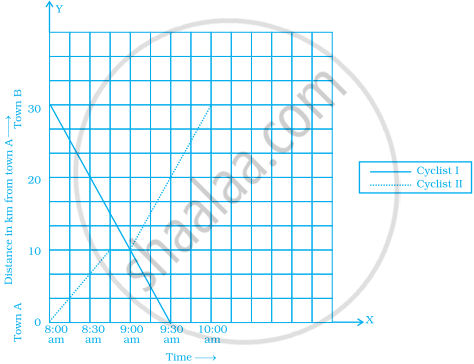
The following graph shows the journey made by two cyclists, one from town A to B and the other from town B to A.
- At what time did cyclist II rest? How long did the cyclist rest?
- Was cyclist II cycling faster or slower after the rest?
- At what time did the two cyclists meet?
- How far had cyclist II travelled when he met cyclist I?
- When cyclist II reached town A, how far was cyclist I from town B?
The two graphs below compare Car A and Car B. The left graph shows the relationship between age and value. The right graph shows the relationship between size and maximum speed.
 |
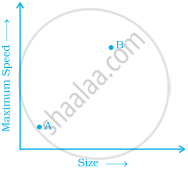 |
Use the graphs to determine whether each statement is true or false, and explain your answer.
- The older car is less valuable.
- The faster car is larger.
- The larger car is older.
- The faster car is older.
- The more valuable car is slower.
