Advertisements
Advertisements
प्रश्न
Explain the situations represented by the following distance-time graph.

Advertisements
उत्तर
Here x-axis represents time and y-axis represents distance.
In the graph, we observe that initially graph increases steadily i.e. at uniform speed and after a certain period of time, it comes to rest position i.e. constant.
APPEARS IN
संबंधित प्रश्न
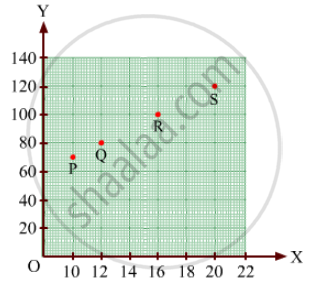
Find the coordinates of points P, Q, R and S in Fig. 27.8.
Decide which of the following statement is true and which is false. Give reasons for your answer.
A point whose x-coordinate is zero, will lie on the y-axis.
The x-coordinate of any point lying on the y-axis will be ______.
A point has 5 as its x–coordinate and 4 as its y–coordinate. Then the coordinates of the point are given by ______.
The distance of any point from the x-axis is called the x-coordinate.
The coordinates of the origin are (0, 0).
Match the coordinates given in Column A with the items mentioned in Column B.
| Column A | Column B |
| (1) (0, 5) | (a) y coordinate is 2 × x - coordinate + 1. |
| (2) (2, 3) | (b) Coordinates of origin. |
| (3) (4, 8) | (c) Only y–coordinate is zero. |
| (4) (3, 7) | (d) The distance from x-axis is 5. |
| (5) (0, 0) | (e) y coordinate is double of x-coordinate. |
| (6) (5, 0) | (f) The distance from y-axis is 2. |
Write the x-coordinate (abscissa) of the given point.
(7, 3)
Plot the given points on a graph sheet and check if the points lie on a straight line. If not, name the shape they form when joined in the given order.
(4, 2), (2, 4), (3, 3), (5, 4)
Sonal and Anmol made a sequence of tile designs from square white tiles surrounding one square purple tile. The purple tiles come in many sizes. Three of the designs are shown below.
(a) Copy and complete the table
| Side Length of Purple Titles | 1 | 2 | 3 | 4 | 5 | 10 | 100 |
| Number of white Tiles in Border |
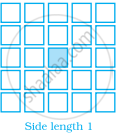 |
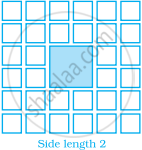 |
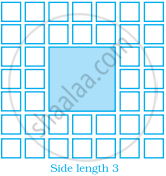 |
(b) Draw a graph using the first five pairs of numbers in your table.
(c) Do the points lie on a line?
