Advertisements
Advertisements
प्रश्न
Plot the following points on a graph sheet. Verify if they lie on a line
A(4, 0), B(4, 2), C(4, 6), D(4, 2.5)
Advertisements
उत्तर
We can plot the given points and join the consecutive points on a graph paper as follows.
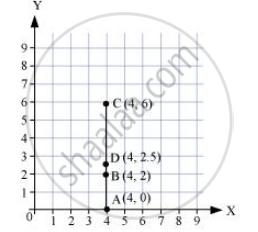
From the graph, it can be observed that the points A, B, C, and D lie on the same line.
संबंधित प्रश्न
Plot the following points on a graph sheet. Verify if they lie on a line
P(1, 1), Q(2, 2), R(3, 3), S(4, 4)
Plot the points (5, 0), (5, 1), (5, 8). Do they lie on a line? What is your observation?
Find the coordinates of points P, Q, R and S in Fig. 27.8.
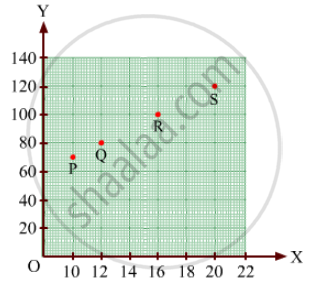
In the given graph the letter that indicates the point (0, 3) is ______.
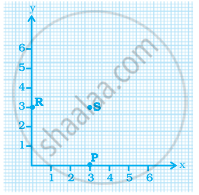
The x-coordinate of any point lying on the y-axis will be ______.
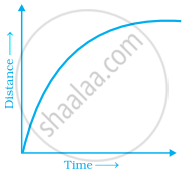
Explain the situations represented by the following distance-time graph.
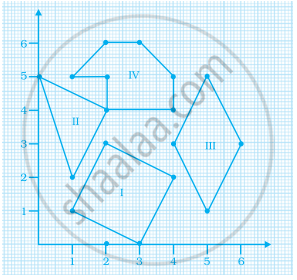
Find the coordinates of the vertices of the given figures.
Study the graph given below of a person who started from his home and returned at the end of the day. Answer the questions that follow.
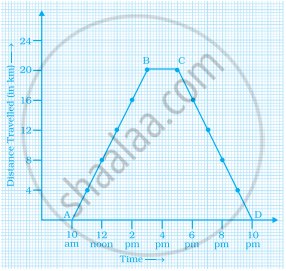
- At what time did the person start from his home?
- How much distance did he travel in the first four hours of his journey?
- What was he doing from 3 pm to 5 pm?
- What was the total distance travelled by him throughout the day?
- Calculate the distance covered by him in the first 8 hours of his journey.
- At what time did he cover 16 km of his journey?
- Calculate the average speed of the man from (a) A to B (b) B to C.
- At what time did he return home?
Locate the points P(3, 4), Q(1, 0), R(0, 4), S(4, 1) on a graph sheet and write the coordinates of the point of intersection of line segments PQ and RS.
