Advertisements
Advertisements
Question
Plot the following points on a graph sheet. Verify if they lie on a line
A(4, 0), B(4, 2), C(4, 6), D(4, 2.5)
Advertisements
Solution
We can plot the given points and join the consecutive points on a graph paper as follows.
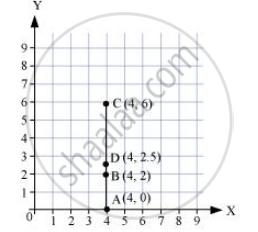
From the graph, it can be observed that the points A, B, C, and D lie on the same line.
RELATED QUESTIONS
Locate the points:
(1, 1), (1, 2), (1, 3), (1, 4)
Find the coordinates of points P, Q, R and S in Fig. 27.8.

Decide which of the following statements is true and which is false. Give reasons for your answer.
The coordinates of the origin are (0, 0).
A point in which the x-coordinate is zero and y-coordinate is non-zero will lie on the ______.
For the point (5, 2), the distance from the x-axis is ______ units.
The distance of any point from the x-axis is called the x-coordinate.
The coordinates of the origin are (0, 0).
Plot the given points on a graph sheet.
- (5, 4)
- (2, 0)
- (3, 1)
- (0, 4)
- (4, 5)
Study the given map of a zoo and answer the following questions.

- Give the location of lions in the zoo.
- (D, f) and (C, d) represent locations of which animals in the zoo?
- Where are the toilets located?
- Give the location of canteen.
Explain the situations represented by the following distance-time graph.

