Advertisements
Advertisements
Question
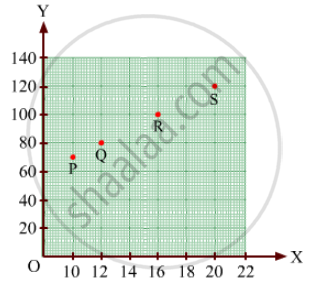
Find the coordinates of points P, Q, R and S in Fig. 27.8.
Advertisements
Solution
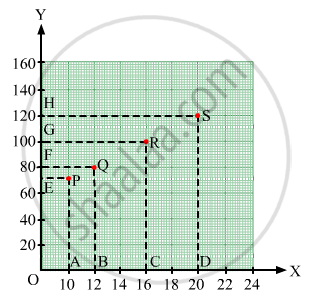
Draw perpendiculars PA, QB, RC and SD from vertices P, Q, R and S on the x-axis. Also ,draw perpendiculars
PE, QF, RG and SH on the y-axis from these points.
PE = 10 units and PA = 70 units
Therefore, the coordinates of vertex P are (10, 70).
QF = 12 units and QB = 80 units
Therefore, the coordinates of vertex Q are (12, 80).
RG = 16 units and RC = 100 units
Therefore, the coordinates of vertex R are (16, 100).
SH = 20 units and SD = 120 units
Therefore, the coordinates of vertex S are (20, 120).
RELATED QUESTIONS
Plot the following points on a graph sheet. Verify if they lie on a line
K(2, 3), L(5, 3), M(5, 5), N(2, 5)
The following table gives the information regarding the number of persons employed to a piece of work and time taken to complete the work:
| Number of persons: | 2 | 4 | 6 | 8 |
| Time taken (in days): | 12 | 6 | 4 | 3 |
Plot a graph of this information.
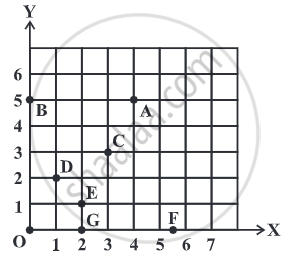
The process of fixing a point with the help of the coordinates is known as ______ of the point.
The distance of any point from the y-axis is the ______ coordinate.
Match the ordinates of the points given in Column A with the items mentioned in Column B.
| Column A | Column B |
| (a) (7, 0) | (i) The ordinate is double the abscissa. |
| (b) (11, 11) | (ii) The ordinate is zero. |
| (c) (4, 8) | (iii) The ordinate is equal to the abscissa. |
| (d) (6, 2) | (iv) The abscissa is double the ordinate. |
| (e) (0, 9) | (v) The abscissa is triple the ordinate. |
| (f) (6, 3) | (vi) The abscissa is zero. |
Write the x-coordinate (abscissa) of the given point.
(7, 3)
Write the x-coordinate (abscissa) of the given point.
(5, 7)
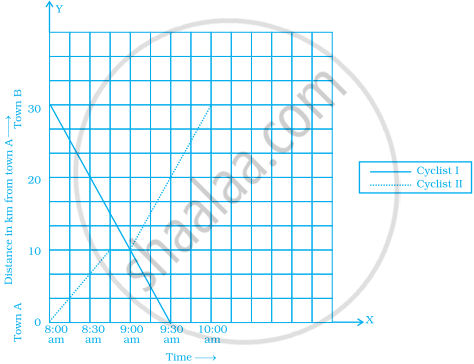
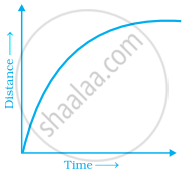
Explain the situations represented by the following distance-time graph.
The following graph shows the journey made by two cyclists, one from town A to B and the other from town B to A.
- At what time did cyclist II rest? How long did the cyclist rest?
- Was cyclist II cycling faster or slower after the rest?
- At what time did the two cyclists meet?
- How far had cyclist II travelled when he met cyclist I?
- When cyclist II reached town A, how far was cyclist I from town B?