Advertisements
Advertisements
Question
Observe the toothpick pattern given below:
(a) Imagine that this pattern continues. Complete the table to show the number of toothpicks in the first six terms.
| Pattern | 1 | 2 | 3 | 4 | 5 | 6 |
| Toothpicks | 4 | 13 |
(b) Make a graph by taking the pattern numbers on the horizontal axis and the number of toothpicks on the vertical axis. Make the horizontal axis from 0 to 10 and the vertical axis from 0 to 30.
(c) Use your graph to predict the number of toothpicks in patterns 7 and 8. Check your answers by actually drawing them.
(d) Would it make sense to join the points on this graph? Explain.
Advertisements
Solution
(a) On the basis of given patterns, we can arrange the following table which show the number of toothpicks in the first six terms.
| Pattern | 1 | 2 | 3 | 4 | 5 | 6 |
| Toothpicks | 4 | 7 | 10 | 13 | 16 | 19 |
Pattern and toothpicks shows the following relation as
1 → 4, 2 → 4 + 3 = 7
3 → 7 + 3 = 10, 4 → 10 + 3 = 13
5 → 13 + 3 = 16, 6 → 16 + 3 = 19
(b) On the basis of given condition, we can draw the following graph

(c) The graph follows the y = 3x + 1 pattern. If x = 7, then y = 3 × 7 + 1 = 21 + 1 = 22 and if x = 8, then y = 3 × 8 + 1 = 24 + 1 = 25.
| x | 7 | 8 |
| y | 22 | 25 |
(d) Yes, it shows the relation between x and y follows the given pattern y = 3x + 1.
APPEARS IN
RELATED QUESTIONS
The distance of any point from the y-axis is the ______ coordinate.
For the point (5, 2), the distance from the x-axis is ______ units.
The points (3, 5) and (5, 3) represent the same point.
The y-coordinate of any point lying on the x-axis will be zero.
Study the given map of a zoo and answer the following questions.
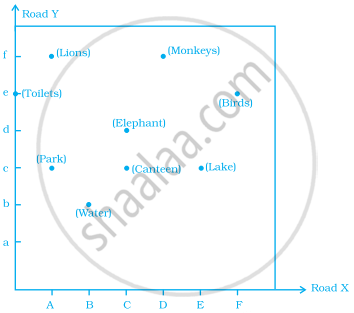
- Give the location of lions in the zoo.
- (D, f) and (C, d) represent locations of which animals in the zoo?
- Where are the toilets located?
- Give the location of canteen.
Write the y-coordinate (ordinate) of the given point.
(3, 5)
If y-coordinate is 3 times x-coordinate, form a table for it and draw a graph.
The following table gives the growth chart of a child.
| Height (in cm) | 75 | 90 | 110 | 120 | 130 |
| Age (in years) | 2 | 4 | 6 | 8 | 10 |
Draw a line graph for the table and answer the questions that follow.
- What is the height at the age of 5 years?
- How much taller was the child at the age of 10 than at the age of 6?
- Between which two consecutive periods did the child grow more faster?
The points on the graph below represent the height and weight of the donkey, dog, crocodile, and ostrich shown in the drawing.
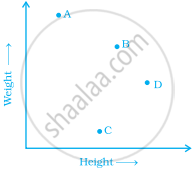
- What are the two variables represented in the graph?
- Which point represents each animals? Explain.
The two graphs below compare Car A and Car B. The left graph shows the relationship between age and value. The right graph shows the relationship between size and maximum speed.
 |
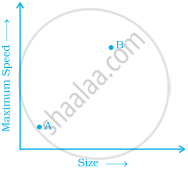 |
Use the graphs to determine whether each statement is true or false, and explain your answer.
- The older car is less valuable.
- The faster car is larger.
- The larger car is older.
- The faster car is older.
- The more valuable car is slower.
