English

Consider this input/output table. Input 1 2 4 5 7 Output 2 5 11 14 20 Graph the values from the table by taking Input along horizontal axis from 0 to 8 and Output along vertical axis from 0 to 24.

Advertisements
Advertisements

Question

Consider this input/output table.

Input 1 2 4 5 7
Output 2 5 11 14 20
  1. Graph the values from the table by taking Input along horizontal axis from 0 to 8 and Output along vertical axis from 0 to 24.
  2. Use your graph to predict the outputs for inputs of 3 and 8.
Graph
Advertisements

Solution

a. On the basis of given input/output table, we can draw the following table.
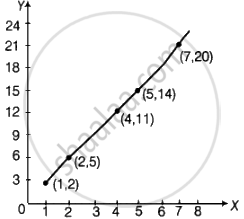
The graph shows y = 3x – 1 pattern.

b. ∴ Pattern is y = 3x – 1

If x = 3, then y = 3 × 3 – 1 = 9 – 1 = 8

If x = 8, then y = 3 × 8 – 1 = 24 – 1 = 23

shaalaa.com
  Is there an error in this question or solution?
Chapter 12: Introduct To Graphs - Exercise [Page 394]

APPEARS IN

NCERT Exemplar Mathematics Exemplar [English] Class 8
Chapter 12 Introduct To Graphs
Exercise | Q 79. | Page 394

Video TutorialsVIEW ALL [1]

RELATED QUESTIONS

State whether True or False. Correct those are false.

A point whose x coordinate is zero and y-coordinate is non-zero will lie on the y-axis.


In the given graph the letter that indicates the point (0, 3) is ______.


______ displays data that changes continuously over periods of time.


In the point (4, 7), 4 denotes the ______.


Study the graph given below of a person who started from his home and returned at the end of the day. Answer the questions that follow.

  1. At what time did the person start from his home?
  2. How much distance did he travel in the first four hours of his journey?
  3. What was he doing from 3 pm to 5 pm?
  4. What was the total distance travelled by him throughout the day?
  5. Calculate the distance covered by him in the first 8 hours of his journey.
  6. At what time did he cover 16 km of his journey?
  7. Calculate the average speed of the man from (a) A to B (b) B to C.
  8. At what time did he return home?

Locate the points A(1, 2), B(3, 4) and C(5, 2) on a graph sheet taking suitable axes. Write the coordinates of the fourth point D to complete the rhombus ABCD. Measure the diagonals of this rhombus and find whether they are equal or not.


The following table gives the growth chart of a child.

Height (in cm) 75 90 110 120 130
Age (in years) 2 4 6 8 10

Draw a line graph for the table and answer the questions that follow.

  1. What is the height at the age of 5 years?
  2. How much taller was the child at the age of 10 than at the age of 6?
  3. Between which two consecutive periods did the child grow more faster?

Extend the line segment on both sides to meet the coordinate axes. What are the coordinates of the points where this line meets the x-axis and the y-axis?


Observe the toothpick pattern given below:

(a) Imagine that this pattern continues. Complete the table to show the number of toothpicks in the first six terms.

Pattern 1 2 3 4 5 6
Toothpicks 4     13    

(b) Make a graph by taking the pattern numbers on the horizontal axis and the number of toothpicks on the vertical axis. Make the horizontal axis from 0 to 10 and the vertical axis from 0 to 30.

(c) Use your graph to predict the number of toothpicks in patterns 7 and 8. Check your answers by actually drawing them.

(d) Would it make sense to join the points on this graph? Explain.


The points on the graph below represent the height and weight of the donkey, dog, crocodile, and ostrich shown in the drawing.

  1. What are the two variables represented in the graph?
  2. Which point represents each animals? Explain.

Share
Notifications

Englishहिंदीमराठी


      Forgot password?
Use app×