Advertisements
Advertisements
Question
Find the coordinates of points A, B, C, D in Fig. 27.7.
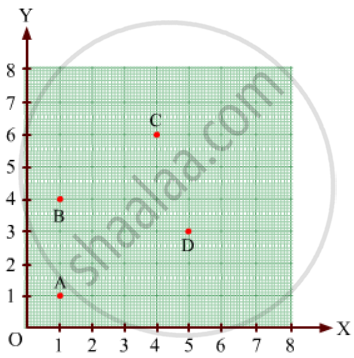
Advertisements
Solution
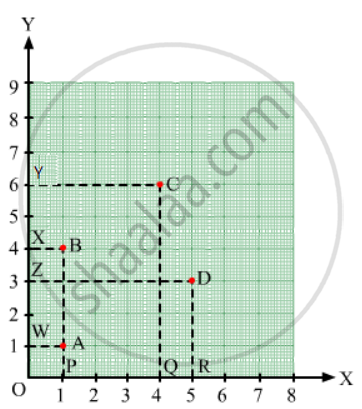
Draw perpendiculars AP, BP, CQ and DR from A, B, C and D on the x-axis. Also, draw perpendiculars AW, BX, CY and DZ on the y-axis.
From the figure, we have:
AW = 1 unit and AP= 1 unit
So, the coordinates of vertex A are (1, 1).
Similarly, BX=1 unit and BP= 4 units
So, the coordinates of vertex B are (1, 4).
CY = 4 units and CQ= 6 units
So, the coordinates of vertex B are (4, 6).
DZ = 5 units and DR= 3 units
So, the coordinates of vertex B are (5, 3).
RELATED QUESTIONS
State whether True or False. Correct those are false.
A point whose x coordinate is zero and y-coordinate is non-zero will lie on the y-axis.
Locate the points:
(1, 3), (2, 3), (3, 3), (4, 3)
The following table shows the amount of rice grown by a farmer in different years:
| Years: | 2000 | 2001 | 2002 | 2003 | 2004 | 2005 | 2006 |
| Rice grown (in quintals): | 200 | 180 | 240 | 260 | 250 | 200 | 270 |
Plot a graph to illustrate this information.
In the given graph the coordinates of point x are ______.
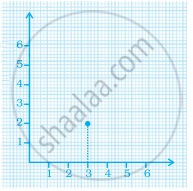
We need ______ coordinates for representing a point on the graph sheet.
All points with y-coordinate as zero lie on the ______.
The y-coordinate of the point (2, 4) is ______.
The coordinates of the origin are (0, 0).
Plot the given points on a graph sheet and check if the points lie on a straight line. If not, name the shape they form when joined in the given order.
(1, 1), (1, 2), (2, 1), (2, 2)
The graph given below compares the price (in Rs) and weight of 6 bags (in kg) of sugar of different brands A, B, C, D, E, F.
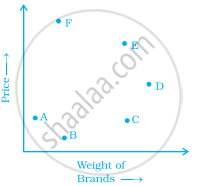
- Which brand(s) costs/cost more than Brand D?
- Bag of which brand of sugar is the heaviest?
- Which brands weigh the same?
- Which brands are heavier than brand B?
- Which bag is the lightest?
- Which bags are of the same price?
