Advertisements
Advertisements
Question
The point where the two axes intersect is called the ______.
Advertisements
Solution
The point where the two axes intersect is called the origin.
Explanation:
The x-axis and y-axis intersect each other at the point representing the origin. Coordinates of origin are (0, 0).
APPEARS IN
RELATED QUESTIONS
Locate the points:
(1, 3), (2, 3), (3, 3), (4, 3)
The following table gives the information regarding length of a side of a square and its area:
| Length of a side (in cm): | 1 | 2 | 3 | 4 | 5 |
| Area of square (in cm2): | 1 | 4 | 9 | 16 | 25 |
Draw a graph to illustrate this information.
For the point (5, 2), the distance from the x-axis is ______ units.
The coordinates of the origin are (0, 0).
Write the x-coordinate (abscissa) of the given point.
(7, 3)
Write the y-coordinate (ordinate) of the given point.
(4, 0)
Plot the given points on a graph sheet and check if the points lie on a straight line. If not, name the shape they form when joined in the given order.
(1, 2), (2, 4), (3, 6), (4, 8)
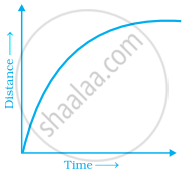
Explain the situations represented by the following distance-time graph.
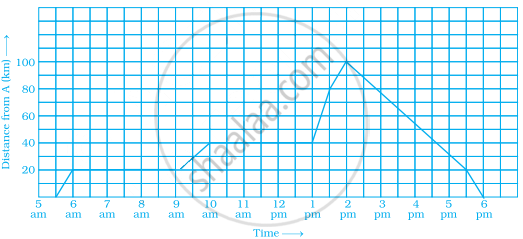
A man started his journey on his car from location A and came back. The given graph shows his position at different times during the whole journey.
- At what time did he start and end his journey?
- What was the total duration of journey?
- Which journey, forward or return, was of longer duration?
- For how many hours did he not move?
- At what time did he have the fastest speed?
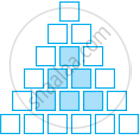
Sonal and Anmol then made another sequence of the designs. Three of the designs are shown below.
 |
 |
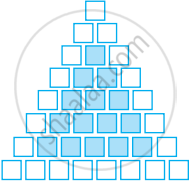 |
(a) Complete the table.
| Rows, r | 4 | 6 | 8 |
| Number of white Tiles, w | 9 | ||
| Number of Purple Tiles, p | 1 |
(b) Draw a graph of rows and number of white tiles. Draw another graph of the number of rows and the number of purple tiles. Put the number of rows on the horizontal axis.
(c) Which graph is linear?
