Advertisements
Advertisements
प्रश्न
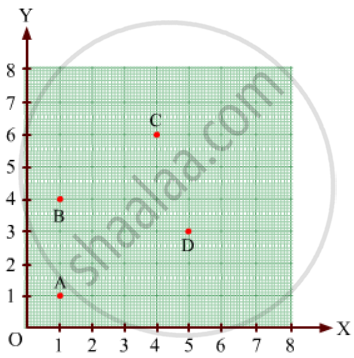
Find the coordinates of points A, B, C, D in Fig. 27.7.
Advertisements
उत्तर
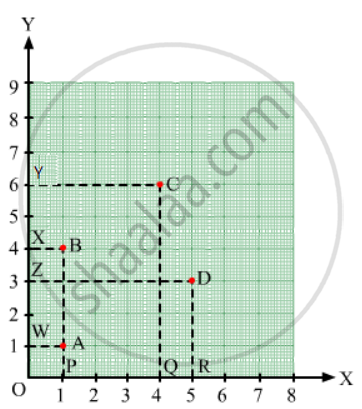
Draw perpendiculars AP, BP, CQ and DR from A, B, C and D on the x-axis. Also, draw perpendiculars AW, BX, CY and DZ on the y-axis.
From the figure, we have:
AW = 1 unit and AP= 1 unit
So, the coordinates of vertex A are (1, 1).
Similarly, BX=1 unit and BP= 4 units
So, the coordinates of vertex B are (1, 4).
CY = 4 units and CQ= 6 units
So, the coordinates of vertex B are (4, 6).
DZ = 5 units and DR= 3 units
So, the coordinates of vertex B are (5, 3).
संबंधित प्रश्न
Plot the following points on a graph sheet. Verify if they lie on a line
A(4, 0), B(4, 2), C(4, 6), D(4, 2.5)
State whether True or False. Correct those are false.
The coordinates of the origin are (0, 0).
Locate the points:
(2, 1), (2, 2), (2, 3), (2, 4)
Decide which of the following statements is true and which is false. Give reasons for your answer.
A point whose y-coordinate is zero, will lie on x-axis.
Decide which of the following statements is true and which is false. Give reasons for your answer.
The coordinates of the origin are (0, 0).
Write the x-coordinate (abscissa) of the given point.
(0, 5)
Make a line graph for the area of a square as per the given table.
| Side (in cm) | 1 | 2 | 3 | 4 |
| Area (in cm2) | 1 | 4 | 9 | 16 |
Is it a linear graph?
The following is the time-distance graph of Sneha’s walking.
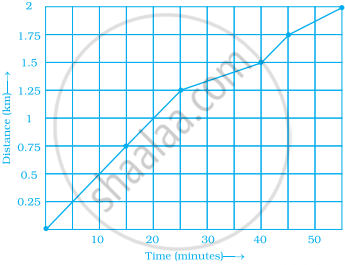
- When does Sneha make the least progress? Explain your reasoning.
- Find her average speed in km/hour.
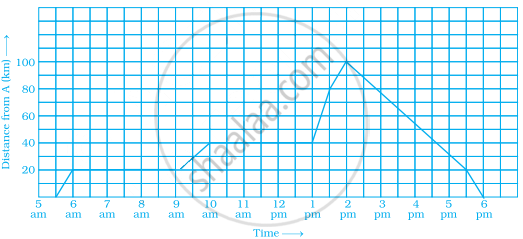
A man started his journey on his car from location A and came back. The given graph shows his position at different times during the whole journey.
- At what time did he start and end his journey?
- What was the total duration of journey?
- Which journey, forward or return, was of longer duration?
- For how many hours did he not move?
- At what time did he have the fastest speed?
The points on the graph below represent the height and weight of the donkey, dog, crocodile, and ostrich shown in the drawing.
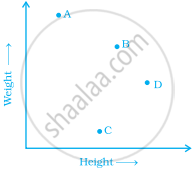
- What are the two variables represented in the graph?
- Which point represents each animals? Explain.
