Advertisements
Advertisements
प्रश्न
The graph given below compares the sales of ice creams of two vendors for a week.
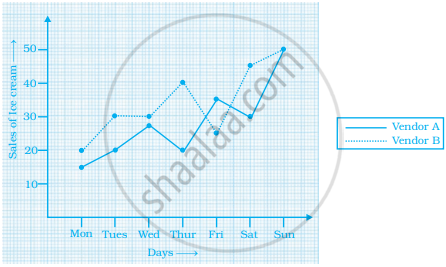
Observe the graph and answer the following questions.
- Which vendor has sold more icecreams on Friday?
- For which day was the sales same for both the vendors?
- On which day did the sale of vendor A increase the most as compared to the previous day?
- On which day was the difference in sales the maximum?
- On which two days was the sales same for vendor B?
Advertisements
उत्तर
Observing the graph carefully, we conclude that
- Vendor A has sold more ice-creams on Friday.
- On Sunday, the sales was the same for both the vendors.
- On Sunday, the sale of vendor A increased the most as compared to Saturday.
- The difference in sales was the maximum on Thursday.
- On Tuesday and Wednesday, the sales was the same for vendor B.
APPEARS IN
संबंधित प्रश्न
Plot the following points on a graph sheet. Verify if they lie on a line
A(4, 0), B(4, 2), C(4, 6), D(4, 2.5)
Plot the following points on a graph sheet. Verify if they lie on a line
P(1, 1), Q(2, 2), R(3, 3), S(4, 4)
Decide which of the following statements is true and which is false. Give reasons for your answer.
The coordinates of the origin are (0, 0).
A point in which the x-coordinate is zero and y-coordinate is non-zero will lie on the ______.
For the point (5, 2), the distance from the x-axis is ______ units.
From the given graph, choose the letters that indicate the location of the points given below.
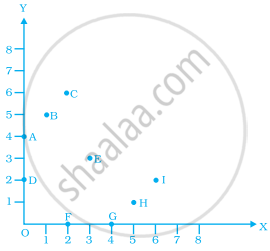
- (2, 0)
- (0, 4)
- (5, 1)
- (2, 6)
- (3, 3)
Write the y-coordinate (ordinate) of the given point.
(3, 5)
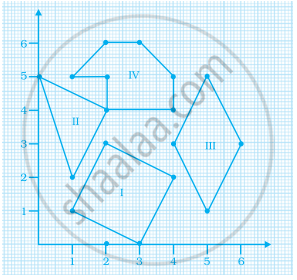
Find the coordinates of the vertices of the given figures.
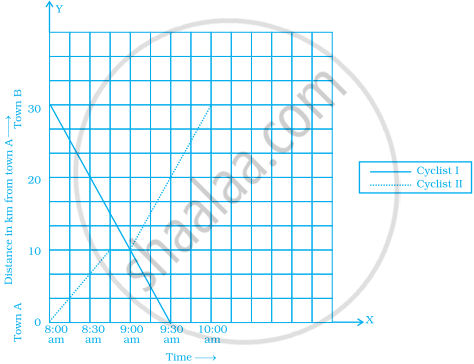
The following graph shows the journey made by two cyclists, one from town A to B and the other from town B to A.
- At what time did cyclist II rest? How long did the cyclist rest?
- Was cyclist II cycling faster or slower after the rest?
- At what time did the two cyclists meet?
- How far had cyclist II travelled when he met cyclist I?
- When cyclist II reached town A, how far was cyclist I from town B?