Advertisements
Advertisements
प्रश्न
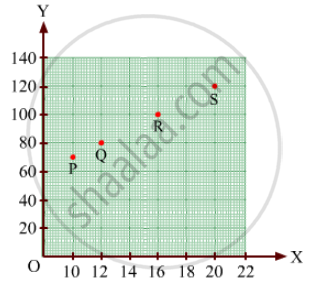
Find the coordinates of points P, Q, R and S in Fig. 27.8.
Advertisements
उत्तर
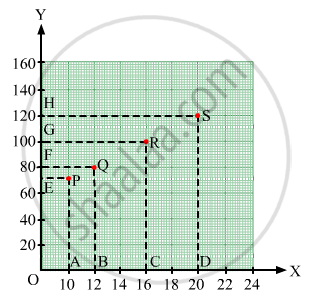
Draw perpendiculars PA, QB, RC and SD from vertices P, Q, R and S on the x-axis. Also ,draw perpendiculars
PE, QF, RG and SH on the y-axis from these points.
PE = 10 units and PA = 70 units
Therefore, the coordinates of vertex P are (10, 70).
QF = 12 units and QB = 80 units
Therefore, the coordinates of vertex Q are (12, 80).
RG = 16 units and RC = 100 units
Therefore, the coordinates of vertex R are (16, 100).
SH = 20 units and SD = 120 units
Therefore, the coordinates of vertex S are (20, 120).
संबंधित प्रश्न
State whether True or False. Correct those are false.
A point whose y coordinate is zero and x-coordinate is 5 will lie on y-axis.
We need ______ coordinates for representing a point on the graph sheet.
The distance of any point from the y-axis is the ______ coordinate.
In the point (4, 7), 4 denotes the ______.
The y-coordinate of any point lying on the x-axis will be zero.
Match the coordinates given in Column A with the items mentioned in Column B.
| Column A | Column B |
| (1) (0, 5) | (a) y coordinate is 2 × x - coordinate + 1. |
| (2) (2, 3) | (b) Coordinates of origin. |
| (3) (4, 8) | (c) Only y–coordinate is zero. |
| (4) (3, 7) | (d) The distance from x-axis is 5. |
| (5) (0, 0) | (e) y coordinate is double of x-coordinate. |
| (6) (5, 0) | (f) The distance from y-axis is 2. |
Write the y-coordinate (ordinate) of the given point.
(4, 0)
The graph given below compares the sales of ice creams of two vendors for a week.
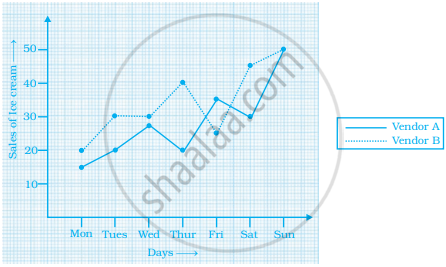
Observe the graph and answer the following questions.
- Which vendor has sold more icecreams on Friday?
- For which day was the sales same for both the vendors?
- On which day did the sale of vendor A increase the most as compared to the previous day?
- On which day was the difference in sales the maximum?
- On which two days was the sales same for vendor B?
This graph shows the per cent of students who dropped out of school after completing High School. The point labelled A shows that, in 1996, about 4.7% of students dropped out.

- In which year was the dropout the rate highest? In which year was it the lowest?
- When did the per cent of students who dropped out of high school first fall below 5%?
- About what per cent of students dropped out of high school in 2007? About what per cent of students stayed in high school in 2008?
Observe the toothpick pattern given below:
(a) Imagine that this pattern continues. Complete the table to show the number of toothpicks in the first six terms.
| Pattern | 1 | 2 | 3 | 4 | 5 | 6 |
| Toothpicks | 4 | 13 |
(b) Make a graph by taking the pattern numbers on the horizontal axis and the number of toothpicks on the vertical axis. Make the horizontal axis from 0 to 10 and the vertical axis from 0 to 30.
(c) Use your graph to predict the number of toothpicks in patterns 7 and 8. Check your answers by actually drawing them.
(d) Would it make sense to join the points on this graph? Explain.
