Advertisements
Advertisements
Question
Explain the situations represented by the following distance-time graph.

Advertisements
Solution
Here x-axis represents time and y-axis represents distance.
In the first graph, we observe that when time changes, distance also varies at the same rate.
When we move along time axis away from the origin, then the graph is strictly increasing.
Hence, the object is moving at a uniform speed.
APPEARS IN
RELATED QUESTIONS
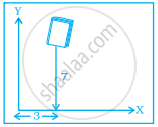
In the given figure the position of the book on the table may be given by ______.
A point has 5 as its x–coordinate and 4 as its y–coordinate. Then the coordinates of the point are given by ______.
The points (3, 5) and (5, 3) represent the same point.
Write the x-coordinate (abscissa) of the given point.
(7, 3)
Write the x-coordinate (abscissa) of the given point.
(5, 7)
Write the y-coordinate (ordinate) of the given point.
(2, 7)
The following is the time-distance graph of Sneha’s walking.
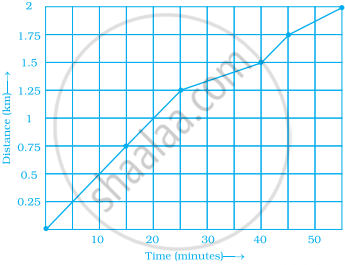
- When does Sneha make the least progress? Explain your reasoning.
- Find her average speed in km/hour.
Draw a parallelogram ABCD on a graph paper with the coordinates given in Table I. Use this table to complete Tables II and III to get the coordinates of E, F, G, H and J, K, L, M.
| Point | (x, y) |
| A | (1, 1) |
| B | (4. 4) |
| C | (8, 4) |
| D | (5, 1) |
Table I
| Point | (0.5x, 0.5y) |
| E | (0.5, 0.5) |
| F | |
| G | |
| H |
Table II
| Point | (2x, 1.5y) |
| J | (2, 1.5) |
| K | |
| L | |
| M |
Table III
Draw parallelograms EFGH and JKLM on the same graph paper.
Plot the points (2, 4) and (4, 2) on a graph paper, then draw a line segment joining these two points.
The two graphs below compare Car A and Car B. The left graph shows the relationship between age and value. The right graph shows the relationship between size and maximum speed.
 |
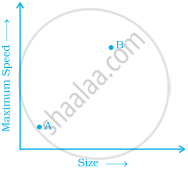 |
Use the graphs to determine whether each statement is true or false, and explain your answer.
- The older car is less valuable.
- The faster car is larger.
- The larger car is older.
- The faster car is older.
- The more valuable car is slower.
