Advertisements
Advertisements
प्रश्न
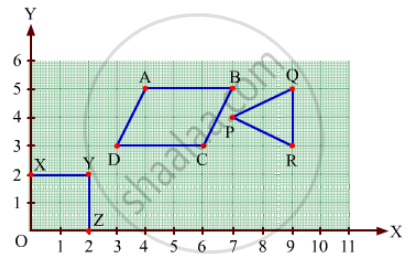
Write the coordinates of each of the vertices of each polygon in Fig. 27.9.
Advertisements
उत्तर
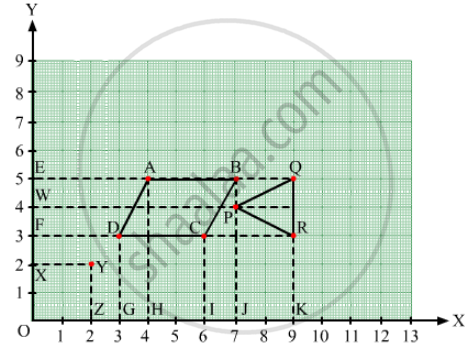
From the figure, we have:
In polygon OXYZ:
O lies on the origin and the coordinates of the origin are (0, 0). So, the coordinates of O are (0, 0).
X lies on the y-axis. So, the x-coordinate is 0. Hence, the coordinate of X is (0, 2).
Also, YX is equal to 2 units and YZ is equal to 2 units. So, the coordinates of vertex Y are (2, 2).
Z lies on the x-axis. So, the y-coordinate is 0. Hence, the coordinates of Z are (2, 0).
In polygon ABCD:
Draw perpendiculars DG, AH, CI and BJ from A, B, C and D on the x-axis.
Also, draw perpendiculars DF, AE, CF and BE from A, B, C and D on the y-axis.
Now, from the figure:
DF = 3 units and DG = 3 units
Therefore, the coordinates of D are (3, 3).
AE = 4 units and AH = 5 units
Therefore, the coordinates of A are (4, 5).
CF = 6 units and CI = 3 units
Therefore, the coordinates of C are (6, 3).
BE = 7 units and BJ = 5 units
Therefore, the coordinates of B are (7, 5).
In polygon PQR:
Draw perpendiculars PJ, QK and RK from P, Q and R on the x-axis.
Also, draw perpendiculars PW, QE and RF from P, Q and R on the y-axis.
Now, from the figure:
PW = 7 units and PJ = 4 units
Therefore, the coordinates of P are (7, 4).
QE = 9 units and QK = 5 units
Therefore, the coordinates of Q are (9, 5).
RF = 9 units and RK = 3 units
Therefore, the coordinates of R are (9, 3).
संबंधित प्रश्न
Decide which of the following statements is true and which is false. Give reasons for your answer.
The coordinates of the origin are (0, 0).
The distance of any point from the x-axis is called the x-coordinate.
The ordinate of a point is its distance from the y-axis.
The y-coordinate of any point lying on the x-axis will be zero.
Match the ordinates of the points given in Column A with the items mentioned in Column B.
| Column A | Column B |
| (a) (7, 0) | (i) The ordinate is double the abscissa. |
| (b) (11, 11) | (ii) The ordinate is zero. |
| (c) (4, 8) | (iii) The ordinate is equal to the abscissa. |
| (d) (6, 2) | (iv) The abscissa is double the ordinate. |
| (e) (0, 9) | (v) The abscissa is triple the ordinate. |
| (f) (6, 3) | (vi) The abscissa is zero. |
Write the y-coordinate (ordinate) of the given point.
(2, 7)
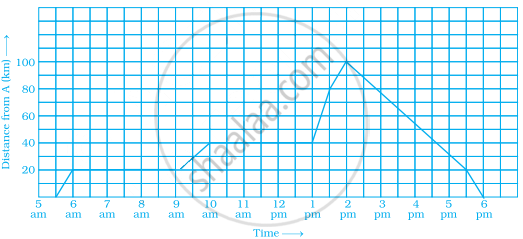
Explain the situations represented by the following distance-time graph.

A man started his journey on his car from location A and came back. The given graph shows his position at different times during the whole journey.
- At what time did he start and end his journey?
- What was the total duration of journey?
- Which journey, forward or return, was of longer duration?
- For how many hours did he not move?
- At what time did he have the fastest speed?
Ajita starts off from home at 07.00 hours with her father on a scooter that goes at a uniform speed of 30 km/h and drops her at her school after half an hour. She stays in the school till 13.30 hours and takes an auto-rickshaw to return home. The rickshaw has a uniform speed of 10 km/h. Draw the graph for the above situation and also determine the distance of Ajita’s school from her house.
