Advertisements
Advertisements
प्रश्न
The points (3, 5) and (5, 3) represent the same point.
विकल्प
True
False
Advertisements
उत्तर
This statement is False.
Explanation:
Two ordered pairs are equal, if they have same numbers at corresponding slot, i.e. x-coordinates are equal and y-coordinates are equal.
Hence, (3, 5) and (5, 3) are different points.
APPEARS IN
संबंधित प्रश्न
Decide which of the following statement is true and which is false. Give reasons for your answer.
A point whose x-coordinate is zero, will lie on the y-axis.
A point in which the x-coordinate is zero and y-coordinate is non-zero will lie on the ______.
The distance of any point from the y-axis is the ______ coordinate.
The point where the two axes intersect is called the ______.
The distance of any point from the x-axis is called the x-coordinate.
Write the x-coordinate (abscissa) of the given point.
(7, 3)
Write the x-coordinate (abscissa) of the given point.
(0, 5)
Plot the given points on a graph sheet and check if the points lie on a straight line. If not, name the shape they form when joined in the given order.
(1, 1), (1, 2), (2, 1), (2, 2)
The table given below shows the temperatures recorded on a day at different times.
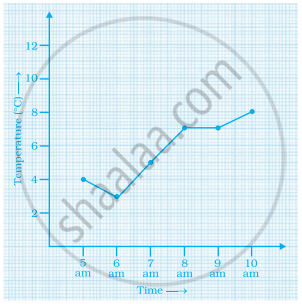
Observe the table and answer the following questions.
- What is the temperature at 8 am?
- At what time is the temperature 3°C?
- During which hour did the temperature fall?
- What is the change in temperature between 7 am and 10 am?
- During which hour was there a constant temperature?
This graph shows the per cent of students who dropped out of school after completing High School. The point labelled A shows that, in 1996, about 4.7% of students dropped out.

- In which year was the dropout the rate highest? In which year was it the lowest?
- When did the per cent of students who dropped out of high school first fall below 5%?
- About what per cent of students dropped out of high school in 2007? About what per cent of students stayed in high school in 2008?
