Advertisements
Advertisements
प्रश्न
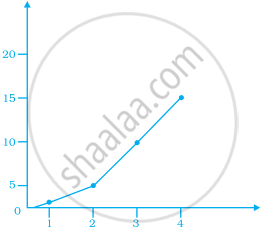
Observe the given graph carefully and complete the table given below.
| x | 1 | 2 | 3 | 4 | 5 |
| y |
Advertisements
उत्तर
Watching the graph carefully, we see that at
x = 1, y = 2.5
x = 2, y = 5
x = 3, y = 10
x = 4, y = 15
x = 5, y = 20
∴ We have the following table.
| x | 1 | 2 | 3 | 4 | 5 |
| y | 2.5 | 5 | 10 | 15 | 20 |
APPEARS IN
संबंधित प्रश्न
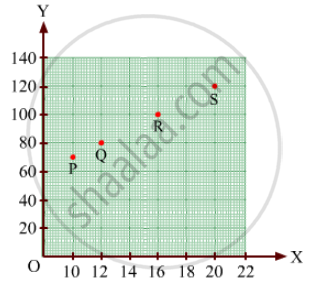
Find the coordinates of points P, Q, R and S in Fig. 27.8.
The coordinates of a point at a distance of 3 units from the x axis and 6 units from the y axis is ______.
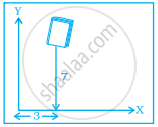
In the given figure the position of the book on the table may be given by ______.
We need ______ coordinates for representing a point on the graph sheet.
The distance of any point from the x-axis is called the x-coordinate.
Match the coordinates given in Column A with the items mentioned in Column B.
| Column A | Column B |
| (1) (0, 5) | (a) y coordinate is 2 × x - coordinate + 1. |
| (2) (2, 3) | (b) Coordinates of origin. |
| (3) (4, 8) | (c) Only y–coordinate is zero. |
| (4) (3, 7) | (d) The distance from x-axis is 5. |
| (5) (0, 0) | (e) y coordinate is double of x-coordinate. |
| (6) (5, 0) | (f) The distance from y-axis is 2. |
Write the y-coordinate (ordinate) of the given point.
(3, 5)
Plot the given points on a graph sheet and check if the points lie on a straight line. If not, name the shape they form when joined in the given order.
(1, 1), (1, 2), (2, 1), (2, 2)
Explain the situations represented by the following distance-time graph.

