Advertisements
Advertisements
प्रश्न
This graph shows the per cent of students who dropped out of school after completing High School. The point labelled A shows that, in 1996, about 4.7% of students dropped out.

- In which year was the dropout the rate highest? In which year was it the lowest?
- When did the per cent of students who dropped out of high school first fall below 5%?
- About what per cent of students dropped out of high school in 2007? About what per cent of students stayed in high school in 2008?
Advertisements
उत्तर
Observing the graph carefully, we have
- The drop out rate was the highest in the year 1990 and the least in 2000.
- In the year 1996, the per cent of students dropped out of high school first fall below 5%.
- About 4.7% students dropped out of high school in 2007.
APPEARS IN
संबंधित प्रश्न
Plot the following points on a graph sheet. Verify if they lie on a line
P(1, 1), Q(2, 2), R(3, 3), S(4, 4)
The following table gives the information regarding length of a side of a square and its area:
| Length of a side (in cm): | 1 | 2 | 3 | 4 | 5 |
| Area of square (in cm2): | 1 | 4 | 9 | 16 | 25 |
Draw a graph to illustrate this information.
In the given figure the position of the book on the table may be given by ______.
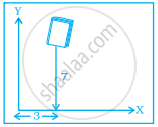
The distance of any point from the y-axis is the ______ coordinate.
All points with y-coordinate as zero lie on the ______.
The x-coordinate of any point lying on the y-axis will be ______.
The point where the two axes intersect is called the ______.
Write the x-coordinate (abscissa) of the given point.
(5, 7)
The points on the graph below represent the height and weight of the donkey, dog, crocodile, and ostrich shown in the drawing.
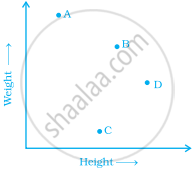
- What are the two variables represented in the graph?
- Which point represents each animals? Explain.
