हिंदी

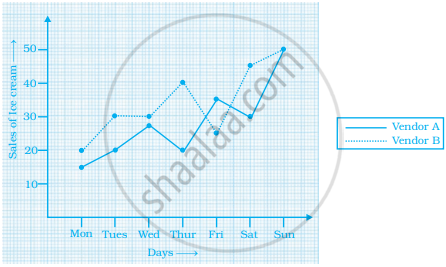
______ displays data that changes continuously over periods of time.

Advertisements
Advertisements

प्रश्न

______ displays data that changes continuously over periods of time.

रिक्त स्थान भरें
Advertisements

उत्तर

Line graph displays data that changes continuously over periods of time.

Explanation:

We have already discussed in the previous question that a line graph displays data that changes continuously over periods of time.

shaalaa.com
  क्या इस प्रश्न या उत्तर में कोई त्रुटि है?
अध्याय 12: Introduct To Graphs - Exercise [पृष्ठ ३७५]

APPEARS IN

एनसीईआरटी एक्झांप्लर Mathematics Exemplar [English] Class 8
अध्याय 12 Introduct To Graphs
Exercise | Q 11. | पृष्ठ ३७५

वीडियो ट्यूटोरियलVIEW ALL [1]

संबंधित प्रश्न

Locate the points:

(1, 4), (2, 4), (3, 4), (4, 4).


Decide which of the following statement is true and which is false. Give reasons for your answer.

 A point whose x-coordinate is zero, will lie on the y-axis.


Match the ordinates of the points given in Column A with the items mentioned in Column B.

Column A Column B
(a) (7, 0) (i) The ordinate is double the abscissa.
(b) (11, 11) (ii) The ordinate is zero.
(c) (4, 8) (iii) The ordinate is equal to the abscissa.
(d) (6, 2) (iv) The abscissa is double the ordinate.
(e) (0, 9) (v) The abscissa is triple the ordinate.
(f) (6, 3) (vi) The abscissa is zero.

Write the y-coordinate (ordinate) of the given point.

(4, 0)


Make a line graph for the area of a square as per the given table.

Side (in cm) 1 2 3 4
Area (in cm2) 1 4 9 16

Is it a linear graph?


Study the graph given below of a person who started from his home and returned at the end of the day. Answer the questions that follow.

  1. At what time did the person start from his home?
  2. How much distance did he travel in the first four hours of his journey?
  3. What was he doing from 3 pm to 5 pm?
  4. What was the total distance travelled by him throughout the day?
  5. Calculate the distance covered by him in the first 8 hours of his journey.
  6. At what time did he cover 16 km of his journey?
  7. Calculate the average speed of the man from (a) A to B (b) B to C.
  8. At what time did he return home?

Draw a parallelogram ABCD on a graph paper with the coordinates given in Table I. Use this table to complete Tables II and III to get the coordinates of E, F, G, H and J, K, L, M.

Point (x, y)
A (1, 1)
B (4. 4)
C (8, 4)
D (5, 1)

     Table I

Point (0.5x, 0.5y)
E (0.5, 0.5)
F  
G  
H  

     Table II

Point (2x, 1.5y)
J (2, 1.5)
K  
L  
M  

    Table III

Draw parallelograms EFGH and JKLM on the same graph paper.

Plot the points (2, 4) and (4, 2) on a graph paper, then draw a line segment joining these two points.


Extend the line segment on both sides to meet the coordinate axes. What are the coordinates of the points where this line meets the x-axis and the y-axis?


A man started his journey on his car from location A and came back. The given graph shows his position at different times during the whole journey.

  1. At what time did he start and end his journey?
  2. What was the total duration of journey?
  3. Which journey, forward or return, was of longer duration?
  4. For how many hours did he not move?
  5. At what time did he have the fastest speed?


This graph shows a map of an island just off the coast of a continent. The point labelled B represents a major city on the coast. The distance between grid lines represents 1 km.

Point A represents a resort that is located 5 km East and 3 km North of Point B. The values 5 and 3 are the coordinates of Point A. The coordinates can be given as the ordered pair (5, 3), where 5 is the horizontal coordinate and 3 is the vertical coordinate.

(i) On a copy of the map, mark the point that is 3 km East and 5 km North of Point B and label it S. Is Point S in the water or on the island? Is Point S in the same place as Point A?

(ii) Mark the point that is 7 km east and 5 km north of Point B and label it C. Then mark the point that is 5 km east and 7 km north of Point B and label it D. Are Points C and D in the same place? Give the coordinates of Points C and D.

(iii) Which point is in the water, (2, 7) or (7, 2)? Mark the point which is in water on your map and label it E.

(iv) Give the coordinates of two points on the island that are exactly 2 km from Point A.

(v) Give the coordinates of the point that is halfway between Points L and P.

(vi) List three points on the island with their x-coordinates greater than 8.

(vii) List three points on the island with a y-coordinate less than 4.


Share
Notifications

Englishहिंदीमराठी


      Forgot password?
Use app×