Advertisements
Advertisements
Question
______ displays data that changes continuously over periods of time.
Advertisements
Solution
Line graph displays data that changes continuously over periods of time.
Explanation:
We have already discussed in the previous question that a line graph displays data that changes continuously over periods of time.
APPEARS IN
RELATED QUESTIONS
State whether True or False. Correct those are false.
A point whose y coordinate is zero and x-coordinate is 5 will lie on y-axis.
Locate the points:
(2, 1), (2, 2), (2, 3), (2, 4)
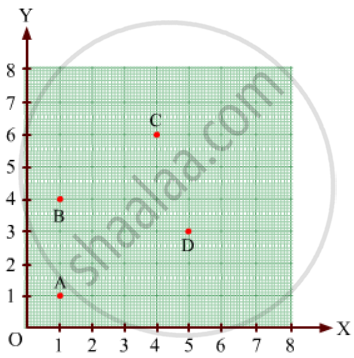
Find the coordinates of points A, B, C, D in Fig. 27.7.
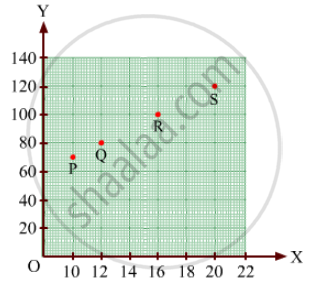
Find the coordinates of points P, Q, R and S in Fig. 27.8.
Decide which of the following statements is true and which is false. Give reasons for your answer.
A point whose y-coordinate is zero, will lie on x-axis.
In the coordinates of a point, the second number denotes the ______.
Plot the given points on a graph sheet and check if the points lie on a straight line. If not, name the shape they form when joined in the given order.
(1, 2), (2, 4), (3, 6), (4, 8)
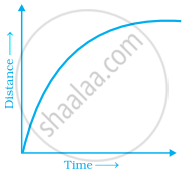
Explain the situations represented by the following distance-time graph.
Draw a parallelogram ABCD on a graph paper with the coordinates given in Table I. Use this table to complete Tables II and III to get the coordinates of E, F, G, H and J, K, L, M.
| Point | (x, y) |
| A | (1, 1) |
| B | (4. 4) |
| C | (8, 4) |
| D | (5, 1) |
Table I
| Point | (0.5x, 0.5y) |
| E | (0.5, 0.5) |
| F | |
| G | |
| H |
Table II
| Point | (2x, 1.5y) |
| J | (2, 1.5) |
| K | |
| L | |
| M |
Table III
Draw parallelograms EFGH and JKLM on the same graph paper.
Plot the points (2, 4) and (4, 2) on a graph paper, then draw a line segment joining these two points.
