Advertisements
Advertisements
Question
Match the coordinates given in Column A with the items mentioned in Column B.
| Column A | Column B |
| (1) (0, 5) | (a) y coordinate is 2 × x - coordinate + 1. |
| (2) (2, 3) | (b) Coordinates of origin. |
| (3) (4, 8) | (c) Only y–coordinate is zero. |
| (4) (3, 7) | (d) The distance from x-axis is 5. |
| (5) (0, 0) | (e) y coordinate is double of x-coordinate. |
| (6) (5, 0) | (f) The distance from y-axis is 2. |
Advertisements
Solution
| Column A | Column B |
| (1) (0, 5) | (d) The distance from x-axis is 5. |
| (2) (2, 3) | (f) The distance from y-axis is 2. |
| (3) (4, 8) | (e) y coordinate is double of x –coordinate. |
| (4) (3, 7) | (a) y coordinate is 2 × x - coordinate + 1. |
| (5) (0, 0) | (b) Coordinates of origin. |
| (6) (5, 0) | (c) Only y–coordinate is zero. |
Explanation:
(1) In the pair (0, 5), the second number also known as ordinate represents the distance from x-axis, i.e. 5.
(2) In the pair (2, 3), 2 the first number, also known as abscissa represents the distance from y-axis that is 2.
(3) We have the coordinates (4, 8). Clearly, coordinate is double of x-coordinate.
(4) We have the coordinate (3, 7), where x-coordinate = 3 and y-coordinate = 7
Evidently, y-coordinate = 2 × x-coordinate + 1
(5) (0, 0) are the coordinates of origin.
(6) In the point (5, 0), the y-coordinate is zero.
APPEARS IN
RELATED QUESTIONS
The following table shows the amount of rice grown by a farmer in different years:
| Years: | 2000 | 2001 | 2002 | 2003 | 2004 | 2005 | 2006 |
| Rice grown (in quintals): | 200 | 180 | 240 | 260 | 250 | 200 | 270 |
Plot a graph to illustrate this information.
The following table gives the information regarding length of a side of a square and its area:
| Length of a side (in cm): | 1 | 2 | 3 | 4 | 5 |
| Area of square (in cm2): | 1 | 4 | 9 | 16 | 25 |
Draw a graph to illustrate this information.
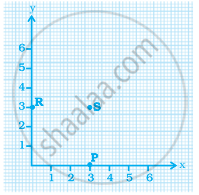
In the given graph the letter that indicates the point (0, 3) is ______.
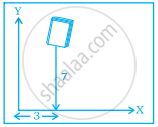
In the given figure the position of the book on the table may be given by ______.
A point in which the x-coordinate is zero and y-coordinate is non-zero will lie on the ______.
All points with y-coordinate as zero lie on the ______.
Write the x-coordinate (abscissa) of the given point.
(0, 5)
Draw a parallelogram ABCD on a graph paper with the coordinates given in Table I. Use this table to complete Tables II and III to get the coordinates of E, F, G, H and J, K, L, M.
| Point | (x, y) |
| A | (1, 1) |
| B | (4. 4) |
| C | (8, 4) |
| D | (5, 1) |
Table I
| Point | (0.5x, 0.5y) |
| E | (0.5, 0.5) |
| F | |
| G | |
| H |
Table II
| Point | (2x, 1.5y) |
| J | (2, 1.5) |
| K | |
| L | |
| M |
Table III
Draw parallelograms EFGH and JKLM on the same graph paper.
Plot the points (2, 4) and (4, 2) on a graph paper, then draw a line segment joining these two points.
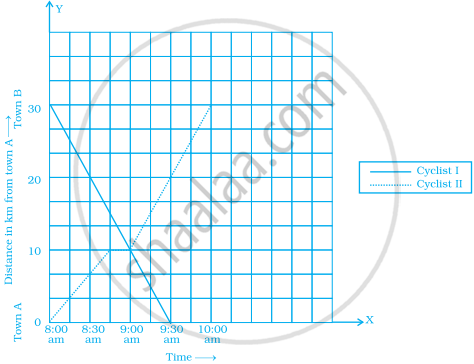
The following graph shows the journey made by two cyclists, one from town A to B and the other from town B to A.
- At what time did cyclist II rest? How long did the cyclist rest?
- Was cyclist II cycling faster or slower after the rest?
- At what time did the two cyclists meet?
- How far had cyclist II travelled when he met cyclist I?
- When cyclist II reached town A, how far was cyclist I from town B?