Advertisements
Advertisements
प्रश्न
Match the coordinates given in Column A with the items mentioned in Column B.
| Column A | Column B |
| (1) (0, 5) | (a) y coordinate is 2 × x - coordinate + 1. |
| (2) (2, 3) | (b) Coordinates of origin. |
| (3) (4, 8) | (c) Only y–coordinate is zero. |
| (4) (3, 7) | (d) The distance from x-axis is 5. |
| (5) (0, 0) | (e) y coordinate is double of x-coordinate. |
| (6) (5, 0) | (f) The distance from y-axis is 2. |
Advertisements
उत्तर
| Column A | Column B |
| (1) (0, 5) | (d) The distance from x-axis is 5. |
| (2) (2, 3) | (f) The distance from y-axis is 2. |
| (3) (4, 8) | (e) y coordinate is double of x –coordinate. |
| (4) (3, 7) | (a) y coordinate is 2 × x - coordinate + 1. |
| (5) (0, 0) | (b) Coordinates of origin. |
| (6) (5, 0) | (c) Only y–coordinate is zero. |
Explanation:
(1) In the pair (0, 5), the second number also known as ordinate represents the distance from x-axis, i.e. 5.
(2) In the pair (2, 3), 2 the first number, also known as abscissa represents the distance from y-axis that is 2.
(3) We have the coordinates (4, 8). Clearly, coordinate is double of x-coordinate.
(4) We have the coordinate (3, 7), where x-coordinate = 3 and y-coordinate = 7
Evidently, y-coordinate = 2 × x-coordinate + 1
(5) (0, 0) are the coordinates of origin.
(6) In the point (5, 0), the y-coordinate is zero.
APPEARS IN
संबंधित प्रश्न
Plot the following points on a graph sheet. Verify if they lie on a line
A(4, 0), B(4, 2), C(4, 6), D(4, 2.5)
Decide which of the following statements is true and which is false. Give reasons for your answer.
A point whose y-coordinate is zero, will lie on x-axis.
Decide which of the following statements is true and which is false. Give reasons for your answer.
The coordinates of the origin are (0, 0).
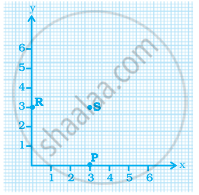
In the given graph the letter that indicates the point (0, 3) is ______.
______ displays data that changes continuously over periods of time.
A point has 5 as its x–coordinate and 4 as its y–coordinate. Then the coordinates of the point are given by ______.
Plot the given points on a graph sheet.
- (5, 4)
- (2, 0)
- (3, 1)
- (0, 4)
- (4, 5)
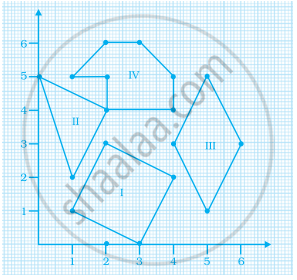
Find the coordinates of the vertices of the given figures.
The following table gives the growth chart of a child.
| Height (in cm) | 75 | 90 | 110 | 120 | 130 |
| Age (in years) | 2 | 4 | 6 | 8 | 10 |
Draw a line graph for the table and answer the questions that follow.
- What is the height at the age of 5 years?
- How much taller was the child at the age of 10 than at the age of 6?
- Between which two consecutive periods did the child grow more faster?
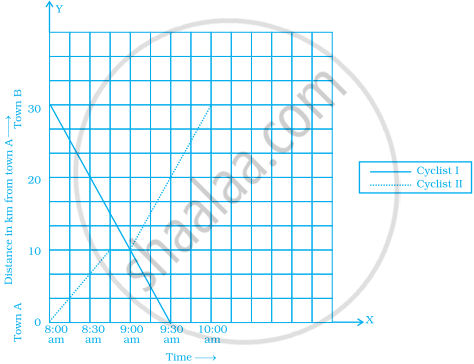
The following graph shows the journey made by two cyclists, one from town A to B and the other from town B to A.
- At what time did cyclist II rest? How long did the cyclist rest?
- Was cyclist II cycling faster or slower after the rest?
- At what time did the two cyclists meet?
- How far had cyclist II travelled when he met cyclist I?
- When cyclist II reached town A, how far was cyclist I from town B?