हिंदी

Locate the points A(1, 2), B(4, 2) and C(1, 4) on a graph sheet taking suitable axes. Write the coordinates of the fourth point D to complete the rectangle ABCD.

Advertisements
Advertisements

प्रश्न

Locate the points A(1, 2), B(4, 2) and C(1, 4) on a graph sheet taking suitable axes. Write the coordinates of the fourth point D to complete the rectangle ABCD.

आलेख
Advertisements

उत्तर

Given, points are A(1, 2), B(4, 2) and C(1, 4).

Location of given points on the graph given below.

To complete the rectangle ABCD, the coordinates of the fourth point D will be (4, 4), i.e. D(4, 4).

shaalaa.com
  क्या इस प्रश्न या उत्तर में कोई त्रुटि है?
अध्याय 12: Introduct To Graphs - Exercise [पृष्ठ ३८६]

APPEARS IN

एनसीईआरटी एक्झांप्लर Mathematics [English] Class 8
अध्याय 12 Introduct To Graphs
Exercise | Q 59. | पृष्ठ ३८६

वीडियो ट्यूटोरियलVIEW ALL [1]

संबंधित प्रश्न

State whether True or False. Correct those are false.

A point whose y coordinate is zero and x-coordinate is 5 will lie on y-axis.


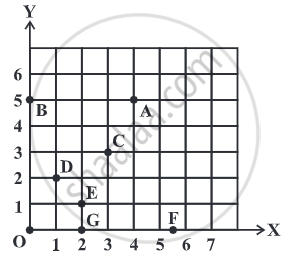
In the given graph the coordinates of point x are ______.


______ displays data that changes continuously over periods of time.


The point where the two axes intersect is called the ______.


For fixing a point on the graph sheet we need two coordinates.


The coordinates of the origin are (0, 0).


Plot the given points on a graph sheet and check if the points lie on a straight line. If not, name the shape they form when joined in the given order.

(1, 1), (1, 2), (2, 1), (2, 2)


The graph given below compares the sales of ice creams of two vendors for a week.


Observe the graph and answer the following questions.

  1. Which vendor has sold more icecreams on Friday?
  2. For which day was the sales same for both the vendors?
  3. On which day did the sale of vendor A increase the most as compared to the previous day?
  4. On which day was the difference in sales the maximum?
  5. On which two days was the sales same for vendor B?

The following graph shows the journey made by two cyclists, one from town A to B and the other from town B to A.

  1. At what time did cyclist II rest? How long did the cyclist rest?
  2. Was cyclist II cycling faster or slower after the rest?
  3. At what time did the two cyclists meet?
  4. How far had cyclist II travelled when he met cyclist I?
  5. When cyclist II reached town A, how far was cyclist I from town B?


Consider this input/output table.

Input 1 2 4 5 7
Output 2 5 11 14 20
  1. Graph the values from the table by taking Input along horizontal axis from 0 to 8 and Output along vertical axis from 0 to 24.
  2. Use your graph to predict the outputs for inputs of 3 and 8.

Share
Notifications

Englishहिंदीमराठी


      Forgot password?
Use app×