Advertisements
Advertisements
Question
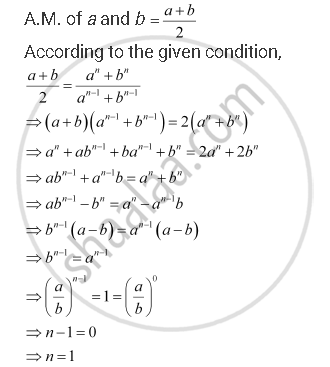
if `(a^n + b^n)/(a^(n-1) + b^(n-1))` is the A.M. between a and b, then find the value of n.
Advertisements
Solution
APPEARS IN
RELATED QUESTIONS
Find the sum of odd integers from 1 to 2001.
In an A.P, the first term is 2 and the sum of the first five terms is one-fourth of the next five terms. Show that 20th term is –112.
If the sum of n terms of an A.P. is 3n2 + 5n and its mth term is 164, find the value of m.
Insert five numbers between 8 and 26 such that the resulting sequence is an A.P.
Between 1 and 31, m numbers have been inserted in such a way that the resulting sequence is an A.P. and the ratio of 7th and (m – 1)th numbers is 5:9. Find the value of m.
Let the sum of n, 2n, 3n terms of an A.P. be S1, S2 and S3, respectively, show that S3 = 3 (S2– S1)
A farmer buys a used tractor for Rs 12000. He pays Rs 6000 cash and agrees to pay the balance in annual installments of Rs 500 plus 12% interest on the unpaid amount. How much will be the tractor cost him?
Shamshad Ali buys a scooter for Rs 22000. He pays Rs 4000 cash and agrees to pay the balance in annual installment of Rs 1000 plus 10% interest on the unpaid amount. How much will the scooter cost him?
A sequence is defined by an = n3 − 6n2 + 11n − 6, n ϵ N. Show that the first three terms of the sequence are zero and all other terms are positive.
Show that the following sequence is an A.P. Also find the common difference and write 3 more terms in case.
3, −1, −5, −9 ...
The nth term of a sequence is given by an = 2n + 7. Show that it is an A.P. Also, find its 7th term.
Find the 12th term from the following arithmetic progression:
3, 5, 7, 9, ... 201
The sum of 4th and 8th terms of an A.P. is 24 and the sum of the 6th and 10th terms is 34. Find the first term and the common difference of the A.P.
If the sum of three numbers in A.P. is 24 and their product is 440, find the numbers.
The angles of a quadrilateral are in A.P. whose common difference is 10°. Find the angles.
Find the sum of the following arithmetic progression :
\[\frac{x - y}{x + y}, \frac{3x - 2y}{x + y}, \frac{5x - 3y}{x + y}\], ... to n terms.
Find the sum of first n natural numbers.
Find the sum of all integers between 84 and 719, which are multiples of 5.
Find the sum of all integers between 100 and 550, which are divisible by 9.
Find the r th term of an A.P., the sum of whose first n terms is 3n2 + 2n.
If \[\frac{b + c}{a}, \frac{c + a}{b}, \frac{a + b}{c}\] are in A.P., prove that:
\[\frac{1}{a}, \frac{1}{b}, \frac{1}{c}\] are in A.P.
If a, b, c is in A.P., prove that:
(a − c)2 = 4 (a − b) (b − c)
If a, b, c is in A.P., prove that:
a3 + c3 + 6abc = 8b3.
Shamshad Ali buys a scooter for Rs 22000. He pays Rs 4000 cash and agrees to pay the balance in annual instalments of Rs 1000 plus 10% interest on the unpaid amount. How much the scooter will cost him.
The income of a person is Rs 300,000 in the first year and he receives an increase of Rs 10000 to his income per year for the next 19 years. Find the total amount, he received in 20 years.
A carpenter was hired to build 192 window frames. The first day he made five frames and each day thereafter he made two more frames than he made the day before. How many days did it take him to finish the job?
Write the common difference of an A.P. the sum of whose first n terms is
If 7th and 13th terms of an A.P. be 34 and 64 respectively, then its 18th term is
If a1, a2, a3, .... an are in A.P. with common difference d, then the sum of the series sin d [cosec a1cosec a2 + cosec a1 cosec a3 + .... + cosec an − 1 cosec an] is
In the arithmetic progression whose common difference is non-zero, the sum of first 3 n terms is equal to the sum of next n terms. Then the ratio of the sum of the first 2 n terms to the next 2 nterms is
If the sum of first n even natural numbers is equal to k times the sum of first n odd natural numbers, then k =
If the first, second and last term of an A.P are a, b and 2a respectively, then its sum is
If in an A.P., Sn = n2p and Sm = m2p, where Sr denotes the sum of r terms of the A.P., then Sp is equal to
Write the quadratic equation the arithmetic and geometric means of whose roots are Aand G respectively.
The first term of an A.P. is a, the second term is b and the last term is c. Show that the sum of the A.P. is `((b + c - 2a)(c + a))/(2(b - a))`.
The product of three numbers in A.P. is 224, and the largest number is 7 times the smallest. Find the numbers
A man saved Rs 66000 in 20 years. In each succeeding year after the first year he saved Rs 200 more than what he saved in the previous year. How much did he save in the first year?
If the sum of n terms of a sequence is quadratic expression then it always represents an A.P
