Advertisements
Advertisements
Question
Form groups and try to write a script for a short film or documentary on any topic of your choice. The script must develop properly. You can take the help of the following points.
- choose a topic
- central theme
- the beginning, the middle, and the end
- the message
Advertisements
Solution
Emma, a dreamy, bubbly young girl of 23, living in the USA, wishes to travel to a foreign land. She wants to visit the cradle of the renaissance, the land of history and beauty, Europe. She expresses this wish before her friends and her mom who willingly encourages her to go on this solo voyage.
All excited about her dream trip, Emma lands up in Rome, from where she had planned to begin her trip. Walking through the quaint lanes of Rome, Emma begins to explore the city. She visits all the important historical monuments spread across, goes on a walking tour around the town, and makes new Roman friends who tell her about the rich history and heritage of their land. They also take her out for shopping and snacking on delicious local food.
However, after having a blast in Rome, Emma moves to Venice where she gets robbed. The thief steals her money, belongings, and crucial documents that are required to fly back to her homeland.
Panicked by this incident, Emma helplessly runs into a church to seek help. Consequently, she meets a number of kind and generous people. She meets a woman who offers her food, a little boy who makes her smile, a young girl who offers her a place to stay and helps her with formalities to fly back to her homeland.
While on her way back home, Emma wonders how life throws at us an unexpected chain of events, and there‟s so much to learn from all of them.
This journey to Europe teaches Emma the lesson to maintain a positive outlook towards life and not break down even in the toughest of situations. It instills in her a faith that life will indeed find its way!
APPEARS IN
RELATED QUESTIONS
Your class had to conduct a Morning Assembly. Write an account of how you prepared for it, what your role was and what you gained from the experience.
It is easy to advise others not to worry, but difficult for oneself to follow the same. Narrate an experience which made you realise the truth of this statement.
In the following items, sentence A is complete, while sentence B is not. Complete sentence B, making it as similar as possible to sentence A. Write sentence B.
(A) His attitude towards his parents has always puzzled the
(B) I have ..................................................................................
What point is the author trying to make?
Thus I entered, and thus I go!
In triumphs, people have dropped down dead,
"Paid by the world, what dost thou owe
Me? "....God might question; now instead,
'Tis God shall repay: I am safer so.
Read the above lines and amswer the question that follow.
Give an example of Antithesis from the poem ‘The Patriot: An Old Story.’
Show how the author uses tone and style to reinforce his memories and make an impact upon his audience.
Discuss trans-culturation as represented in Seattle’s speech.
Show with references from the story how T.S Arthur uses direct and indirect characterisation to highlight the traits of the characters.
After his parents died in a car accident, his uncle looked________him.
This book runs________a hundred and fifty pages.
The ailing company was taken________by the government.
Describe an early morning walk through your city or town in winter. Give details of the smells, sights, sounds, and feelings you experienced.
My daughter believes_____________ fairies.
Given below is an interesting combination of words. Explain why they have been used together.
ghostly dust devils
Notice these expressions in the text. Infer their meaning from the context.
-
Remove
-
slackers
-
muck
-
kept in
-
got carried away
-
cut
-
sadist
-
shrivelled up
Examine the subtle humour in the narration of the story that lightens the gravity of the subject matter.
Give reasons for the following.
Srinath and his family members’ eager expectation of Satyajit’s arrival.
It is difficult to adjust to a fall from glory.
Multiple Choice Question:
The poet had a quarrel with her ______
What is a space shuttle? Name the shuttle which took Kalpana in space.
‘Kalpana Chawla was a heroine’. How did a journalist support his statement?
Give reasons, for us being reluctant to make friends with some strangers, but being comfortable with some, even after meeting them for the first time.
Are friends different from neighbors? Are you friends with your neighbors? Give examples and write.
Use your imagination and extend the story in about 100 to 150 words.
Imagine that Revathi’s father is abroad on business and she wishes to convey the news of her prize - winning plants. Draft an email for the above subject.
(Use an email format.)
Wars are not fought only on the battlefield. Comment.
Discuss with your partner on the following topic. Express your views and opinions in favour of and against the topic.
Are sports essential in Jr. Colleges?
Start a collection of proverbs. A proverb is a short, well-known sentence or phrase that gives advice or tells you what is generally true. For example, ‘A stitch in time saves nine’ means ‘If one does something in time or immediately, it saves a lot of work later’. A proverb is also known as a saying. Here are some proverbs for your collection.
- Appearances can be deceptive.
- Do not judge by appearance; a rich heart may be under a poor coat.
- All that glitters is not gold.
- You can’t tell a book by its cover.
- Clothes do not make the man.
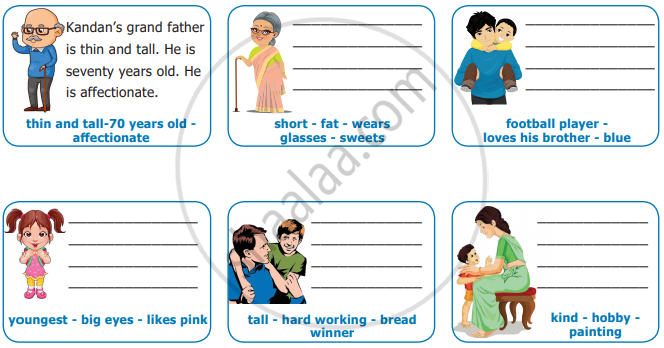
Given in a mixed order below are some good human attributes of the family. Pick out from the box and write it against the line that reflects it.
Fritz felt that someone needed his help and he was determined to find the sender.
Hold a debate on - 'Pets or Pests?'
Write your own interpretation of the story.
Complete the remaining blocks determining the types of news.
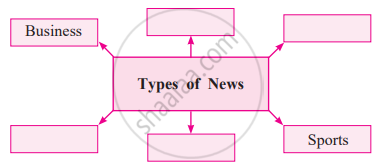
Imagine you are Dorothy and write about the day’s events in 5-8 lines in your (Dorothy’s) diary.
On seeing these pictures, you would have gone down your memory lane. Write a paragraph in about 50 words describing your favourite sport when you were young.

Look at the image of the familiar advertisement given below. Identify the product and try to frame your own slogan for them.

Create a poster for the following.
You are Raja/ Ranjani. Draft a poster to create awareness about the harmful effects of using plastics, in not more than 50 words.
Create a poster for the following.
You are Sita/ Sudhan. Design a poster in not more than 50 words to focus on not wasting water. Be creative.
Do the singers have hopes and dreams? If not, why?
What are the themes of the singers’ songs?
“I cannot come.” Mala said that ______
Complete the paragraph with suitable words from the box.
| around, across, with, along, to, after, next to, into, from. |
One day, as I was walking ______ the bank of the river, I saw my friend running ______ the field. He was calling my name and waving ______ me. I stopped and waited. ______ sometime he reached where I was standing. He said, “I went all ______ the town looking for you. I have some exciting news to share ______ you. Do you remember the old house ______ the neem tree? Guess who is moving ______ that house? Janak Das, the great magician. Now we can learn lots of magic tricks ______ him.”
Reference to context.

Draw pictures of the speakers of the above lines.
Fill in the blanks according to the example given below
| tiny | tinier | tiniest |
| big | ______ | biggest |
| sleepy | sleepier | ______ |
| ______ | lovelier | loveliest |
| ______ | later | ______ |
| round | ______ | ______ |
| small | ______ | ______ |
| good | ______ | best |
Discuss and write –
- Why do cats and dogs fight?
- Why do we walk across the road, not run?
- Why do people like ice-cream?
Find one word from the story that means
to think w ______.
The red tea cups are filled with a particular word. Fill in the yellow tea cups with similar sounding words. Note the example given.

In the sentence below the capital letter, comma, full stop and question mark are missing. Put these in the correct place.
every sunday i go for a walk have breakfast read story books listen to music and watch television
Where did the author study in his childhood?
Why didn’t the grandmother feel sentimental when the author went abroad for higher education?
How is school education in the village different from that in the city?
What does each of the following mean in the story? Choose the right option.
a guardian of peace:
Describe Mary Kom’s personal experiences during her first International Championship match from the time of selection to winning the medal.
Why did K.C’s words shock Sletherby?
What was the human side to the photographer?
Write an e-mail to the General Manager of a local hospital requesting him/her to send a senior doctor to talk to the participants at the event about the quality of mask which would give them the best protection.
Prepare a dialogue from the jumbled sentences:
- It will reach Nagpur at 7: 15 a.m.
- What is the departure time of the Vidarbha Express?
- When will it reach Nagpur?
- The departure time is 8:30 p.m.
On returning home, Tishani Doshi writes her thoughts reflecting on how her decision to enrol for the Students on Ice programme has been the single most important decision of her life that has completely transformed her.
Imagine yourself to be Tishani and express these thoughts.
You may begin like this:
I can’t thank my stars enough for having cashed in on the opportunity of........
Write an original short story that begins with the following words:
My mother stopped suddenly at the doorway and stared in amazement at ..........
Write a composition (in approximately 400-450 words) of the following subject:
Recently you attended the wedding of a close relative. It was the first family gathering after the pandemic. Describe the excitement of meeting all the family members, the venue of the wedding, the food that was served and the celebrations that followed.
