Advertisements
Advertisements
Questions
Collect 5 examples of palindromic DNA sequences. Better try to create a palindromic sequence by following base-pair rules.
Collect 5 examples of palindromic DNA sequences by consulting your teacher. Better try to create a palindromic sequence by following base-pair rules.
Advertisements
Solution
In DNA, a palindrome is a sequence of base pairs that reads the same on both strands when the reading orientation is constant.
| (i) | Eco RI: | 5' G A A T T C 3' |
| 3' C T T A A G 5' | ||
| (ii) | Hind III: | 5' A A G C T T 3' |
| 3' T T C G A A 5' | ||
| (iii) | Bam HI: | 5' G G A T C C 3' |
| 3' C CT A G G 5' | ||
| (iv) | Sal I: | 5' G T C G A C 3' |
| 3' C A G C T G 5' | ||
| (v) | Pst I: | 5' C T G C A G 3' |
| 3' G A C G T C 5' |
APPEARS IN
RELATED QUESTIONS
Name and describe the technique that helps in separating the DNA fragments formed by the use of restriction endonuclease
Make a chart (with diagrammatic representation) showing a restriction enzyme, the substrate DNA on which it acts, the site at which it cuts DNA and the product it produces.
Explain the roles of the following with the help of an example each in recombinant DNA technology :
Restriction Enzymes
Answer the following question.
Explain the significance of palindromic nucleotide sequence in the formation of recombinant DNA.
Give a reason why :
Single cloning site is preferred in a vector.
The total number of nucleotide sequences of DNA that code for a hormone is 1530. The proportion of different bases in the sequence is found to be Adenine = 34%, Guanine = 19%, Cytosine = 23%, Thymine = 19%.
Applying Chargaff’s rule, what conclusion can be drawn?
The DNA fragment separated on an agarose gel can be visualized by staining with ______.
Which of the following radioisotope is not suitable for DNA labeling based studies?
'Restriction' in restriction enzyme refers to
DNA strands on a gel stained with ethidium bromide when viewed under UV radiation, appear as ______
A specific recognition sequence identified by endonucleases to make cuts at specific positions within the DNA is ______
Which of the following enzymes catalyse the removal of nucleotides from the ends of DNA?
Which of the given statements is correct in the context of visualizing DNA molecules separated by agarose gel electrophoresis?
'Restriction' in Restriction enzyme refers to ______.
In agarose gel electrophoresis, DNA molecules are separated on the basis of their ______.
Which of the following bacteria is not a source of restriction endonuclease?
Which of the following statements does not hold true for restriction enzyme?
What does H in’ ‘d’ and ‘III’ refer to in the enzyme Hind III?
Carefully observe the given picture. A mixture of DNA with fragments ranging from 200 base pairs to 2500 base pairs was electrophoresed on agarose gel with the following arrangement.
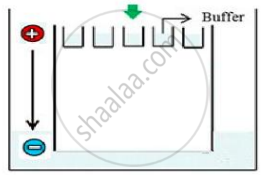
(a) What result will be obtained on staining with ethidium bromide? Explain with reason.
(b) The above setup was modified and a band with 250 base pairs was obtained at X.
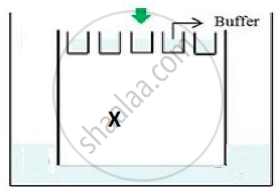
What change(s) were made to the previous design to obtain a band at X? Why did the band appear at position X?
What are the protruding and hanging stretches of DNA produced by these restriction enzymes called? Describe their role in the formation of rDNA.
State the principle involved in separation of DNA fragments using gel electrophoresis.
How are DNA fragments visualised once they are separated by gel electrophoresis?
Identify the activity of endonuclease and exonuclease in the given image.
Hind II always cuts DNA molecules at a particular point called recognition sequence and it consists of ______.
