Advertisements
Advertisements
Question
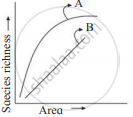
A species-area curve is drawn by plotting the number of species against the area. How is it that when a very large area is considered the slope is steeper than that for smaller areas?
Advertisements
Solution
Ecologists have discovered that the value of Z (slope of the line) lies in the range of 0.1 to 0.2, regardless of the taxonomic group or the region (whether it is the plants in Britain, birds in California or molluscs in New York state, the slopes of the regression line are amazingly similar). But, if you analyse the species-area relationships among very large areas like the entire continents, you will find that the slope of the line is much steeper (Z values in the range of 0.6 to 1.2). For example, for frugivorous (fruit-eating) birds and mammals in the tropical forests of different continents, the slope is found to be 1.15.
APPEARS IN
RELATED QUESTIONS
Explain, giving three reasons, why tropics show greatest levels of species diversity.
Observe the graph and select the correct option:
Short answer type question
Tropical regions exhibit species richness as compared to polar regions. Justify.
The 'rivet' in the rivet popper hypothesis is considered to represent the ______.
Extent of global diversity of invertebrates is shown in the pie diagram below. Choose the most appropriate alternative that the four portions (a-d) represent.

Which of the following hypothesis states: Rich species diversity leads to lesser variation in biomass production over a period of time.
On a log scale the relationship of species richness and area becomes linear (straight line) and is given by the equation.
With reference to graph select the correct alternative
Which of these is true about tropical environments?
Which of the following countries has the highest biodiversity?
What does the term ‘Frugivorous’ mean?
There is greater biodiversity in tropical /subtropical regions than in temperate region. Explain.
Is it true that there is more solar energy available in the tropics? Explain briefly.
For frugivorous (fruit-eating) birds and mammals in the tropical forests of different continents, the slope of the species-area relationship is found to be approximately ______.
The relation between species richness and area for a wide variety of taxa appears as ______.
Alexander von Humboldt observed that, within a region species richness ______ with increasing explored area.
Who observed that within a region, species richness increased with increasing explored area, to a certain limit?
Tropical regions show greatest level of species richness because -
- Tropical latitudes have remained relatively undisturbed for millions of years, hence more time was available for species diversification.
- Tropical environments are more seasonal.
- More solar energy is available in tropics.
- Constant environments promote niche specialization.
- Tropical environments are constant and predictable.
Choose the correct answer form the options given below:
What does the variable Z represent in the species-area relationship formula log S = log C + Z log A?
