Definitions [42]
The rate of flow of electric charge through a cross-section of a conductor.
The opposition offered by a conductor to the flow of electric current.
The work done per unit charge to move a charge between two points in a circuit; it is the driving force for current flow.
An intrinsic property of a material that determines its resistance per unit length and cross-sectional area.
Define the following:
Semiconductors
Semiconductors: Substances whose resistance decreases with the increase in temperature are named as semiconductors. E.g. manganin, constantan etc.
Define an electric current.
An electric current is measured by the amount of electric charge moving per unit time at any point in the circuit.
The magnitude of an electric current is the number of electric charges flowing through a conductor in one second.
Define the following:
Electromotive force
Electromotive force: When no current is drawn from a cell, when the cell is in open circuit, the potential difference between the terminals of the cell is called its electromotive force (or e.m.f.).
Define the following:
Conventional current
The movement of the positive charge is called conventional current.
Define the unit of current.
The unit of electric current is ampere (A). When one coulomb charge flows through an electric circuit in one second, then the electric current flowing through the circuit is said to be an ampere.
Define the term resistivity.
The resistivity of a material is the resistance of a wire of that material of unit length and unit area of cross-section.
A continuous and closed path of an electric current is called an electric circuit.
Current is defined as the rate of flow of charge.
Define the following:
Super conductors
Substances whose resistance decreases tremendously with decreasing temperature and reaches nearly zero near absolute zero are called superconductors; e.g., lead, tin, etc.
The amount of electric current flowing per unit cross-sectional area of a conductor, measured at a point perpendicular to the direction of current flow.
Define the following:
Variable resistor
A variable resistor has a resistance that can be varied. It is used to vary the amount of current flowing in a circuit.
Define the term resistance.
Resistance is the obstacle that the wire presents to the current flow.
Define the following:
Fixed resistor
A fixed resistor has a resistance of a fixed value. Common types of fixed resistors include carbon film resistors and wire-wound resistors.
Conductance is the reciprocal of resistance — a measure of how easily current flows through a conductor.
G = \[\frac {1}{R}\]
Electric resistance is the property of a conductor by virtue of which it opposes the flow of electric current through it.
R = \[\frac {V}{I}\]
Resistivity is a material-dependent property that measures how strongly a material opposes current flow, independent of its shape or size.
ρ = \[\frac {RA}{l}\]
Define Current density.
Current density is a vector quantity, often known as an area vector or cross-sectional area vector, whose value is equal to the electric current flowing per unit area.
J = `"I"/"A"`
S.I unit is A/m2.
One ohm is the resistance of a component when the potential difference of one volt applied across the component drives a current of one ampere through it.
At constant temperature and other physical conditions, the current flowing through a conductor is directly proportional to the potential difference across its ends.
Define temperature coefficient of resistance.
The temperature coefficient is defined as the ratio of the increase in resistivity per degree rise in temperature to its resistivity at T0.
Define the following:
Coulomb
One coulomb is the amount of electric charge transferred by a current of one ampere in one second.
The minimum potential difference required before a measurable current starts flowing through certain devices.
Mobility is the magnitude of drift velocity per unit electric field.
Rate of flow of charge through a cross-section of a conductor.
The average velocity with which free electrons move opposite to the electric field direction inside a conductor, superimposed on their random motion.
Electrical Resistivity (ρ) is defined as the resistance offered by a conductor of unit length and unit cross-sectional area at a given temperature. It is a characteristic property of the material, independent of its dimensions.
In many practical circuits, some resistors are connected in series while others are in parallel within the same network. Such networks are called mixed grouping.
A single resistance that can replace a group of resistors between two points in a circuit without changing the current drawn or the potential difference across those points.
An electric cell is a device that converts chemical energy into electrical energy and maintains a continuous flow of electric current in a circuit by sustaining a constant potential difference between its two terminals.
Electromotive Force (emf) is the work done by a cell (or any energy source) in driving a unit positive charge around the complete circuit, including through the cell itself.
The work done per unit charge in the external circuit only: V = \[\frac {W_{ext}}{q}\]. It is what a voltmeter connected across the cell's terminals actually measures.
The internal resistance (r) of a cell is the resistance offered by the electrolyte and electrodes inside the cell to the flow of ionic current through it.
- SI Unit: ohm (Ω)
- Symbol: r
- Represented in circuits as a resistance in series with the ideal e.m.f. source.
The condition of the Wheatstone bridge under which the galvanometer shows zero (null) deflection, i.e., Ig = 0, is called the balance condition of the bridge.
An arrangement of four resistors used to measure the resistance of one of them in terms of the other three, invented by Samuel Hunter Christie in 1833 and made famous by Sir Charles Wheatstone, is called a Wheatstone bridge.
A metre bridge (slide-wire bridge) is a practical laboratory device based on the Wheatstone bridge principle, used to measure an unknown electrical resistance by achieving a null-point (balance) condition on a one-metre-long uniform resistance wire.
A potentiometer is an instrument used to measure the EMF of a cell, compare EMFs of two cells, or find a cell's internal resistance — all without drawing any current from the cell being measured, making it more accurate than a voltmeter.
Define potential gradient of the potentiometer wire.
The potential gradient of a potentiometer wire is defined as the change in electric potential (voltage) per unit length of the wire.
Mathematically,
Potential Gradient = `V/L`
Define a Potentiometer.
A potentiometer is a manually adjustable, variable resistor with three terminals. Two terminals are connected to the ends of a resistive element, and the third terminal is connected to an adjustable wiper. The position of the wiper sets the resistive divider ratio.
Formulae [7]
I = \[\frac {Q}{t}\]
Where:
- I = electric current
- Q = charge flowing through the conductor
- t = time taken
SI unit of current = ampere (A).
For a conductor of uniform cross-sectional area A carrying current I perpendicular to the surface:
j = \[\frac {I}{A}\]
SI Unit: ampere per square metre (A/m2)
Dimensional Formula: [A L−2]
V ∝ I
V = IR
Other useful forms: I = \[\frac {V}{R}\] or R = \[\frac {V}{I}\]
μ = \[\frac {∣v_d∣}{E}\]
where:
- vd: drift velocity
- E: electric field
If a device draws current I at voltage V for t hours:
ε = \[\frac {dW}{dq}\]
SI Unit: volt (V), where 1 V = 1 J C−1
Dimensional Formula: [ML2T−3A−1]
Balance condition (when Ig = 0):
- AC → battery arm
- BD → galvanometer arm
- R4 → unknown resistance measured in terms of the other three.
Theorems and Laws [10]
Statement: Ohm’s Law
"The electric current flowing through a conductor is directly proportional to the potential difference across its ends, provided the temperature and other physical conditions of the conductor remain constant."
Mathematically,
I ∝ V or V = I R
where:
- V = Potential difference (in volts)
- I = Current (in amperes)
- R = Resistance of the conductor (in ohms, Ω)
Explanation:
When two conductors at different electric potentials are joined by a metallic wire, electrons flow from the conductor at a lower potential (excess electrons) to the one at a higher potential (deficit of electrons). This movement of electrons results in an electric current.
- The current continues to flow until both conductors reach the same potential.
- For continuous current flow, a constant potential difference must be maintained across the ends of the conductor (e.g., using a battery or power supply).
Derivation / Mathematical Proof:
From Ohm’s Law:
I ∝ V ⇒ \[\frac {V}{I}\] = constant
This constant is defined as the resistance (R) of the conductor. Therefore,
V = I R ---(1)
This is the mathematical form of Ohm’s Law.
Special Case:
If the current I = 1 A, then:
V = R
This implies that the resistance of a conductor is numerically equal to the potential difference across it when 1 ampere of current flows through it.
Conclusion:
Ohm's Law provides a fundamental relationship between voltage, current, and resistance in an electric circuit. It is widely used in the design and analysis of electrical and electronic systems.
According to Ohm’s law, the current flowing in a conductor is directly proportional to the potential difference across its ends, provided the physical conditions and temperature of the conductor remain constant.
No, it is not always true. E.g., Diode valve, junction diode, etc., do not obey Ohm’s law.
State Ohm’s law.
According to Ohm’s law, at a constant temperature, the steady current ‘I’ flowing through a conductor is directly proportional to the potential difference ‘V’ between the two ends of the conductor.
I ∝ V
V = IR
The algebraic sum of potential differences in a closed loop is zero.
Based on conservation of energy.
At any junction, the sum of currents entering = the sum of currents leaving.
Example: I1 + I3 = I2 + I4. Based on conservation of charge.
Statement
At any junction in an electric circuit, the sum of currents entering the junction is equal to the sum of currents leaving the junction.
Derivation
When the current in a circuit is steady, charge does not accumulate at any junction. Therefore, the amount of charge entering the junction per second must be equal to the amount of charge leaving the junction per second.
If currents I1 and I2 enter a junction and currents I3 and I4 leave it, then
or
Hence,
Conclusion
Kirchhoff's First Law is a direct consequence of the conservation of charge.
Statement
In any closed loop of an electric circuit, the algebraic sum of all changes in potential is zero.
Derivation
Consider a charge moving around a closed loop. After completing one full loop, the charge returns to its starting point. Since electric potential depends only on position, the net change in potential over a complete loop must be zero.
Therefore, in a closed loop,
If a loop contains cells and resistors, then the total emf supplied by the sources is equal to the total potential drop across the resistors. Thus,
Conclusion
Kirchhoff's Second Law is a direct consequence of the conservation of energy.
Obtain the balancing condition for the Wheatstone bridge arrangements as shown in Figure 4 below:
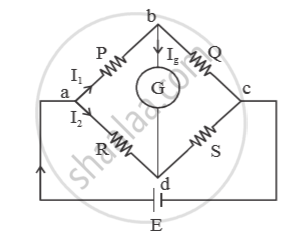
Let `I_3` and `I_4` be the currents in resistors Q and S respectively . Let `I_g` be the current through galvanometer. For balanced condition,
`I_g = 0`
Applying junction law at ‘b’ we get
`I_1 = I_3 + I_g`
`because I_g = 0 , I_1 = I_3` ....(i)
Applying junction law at ‘d’, we get
`I_2 + I_g = I_4`
`because I_g = 0 , I_2 = I_4` ....(ii)
Applying loop law in the loop abda, we get
`-I_1·P - I_g·Q + -I_2·R = 0`
⇒ `-I_1P + I_2R = 0` (`because I_g = 0`)
⇒ `I_1P = I_2R`
⇒ `P/R = I_2/I_1` ....(iii)
Applying loop law in the loop bcdb, we get
`-I_3·Q + I_4·S + I_g·6 = 0`
⇒ `-I_3·Q + I_4·S + 0 = 0 (because I_g =0)`
⇒ `-I_3Q = I_4S`
⇒ `Q/S = I_4/I_3`
⇒ `Q/S = I_2/I_1` ...(iv) [using eq.(i) and (ii)]
From eq. (iii) and (iv), `P/ R = Q/s`
⇒ `P/Q = R/S`
This is the balanced condition.
The metre bridge works on the Wheatstone bridge principle: a bridge circuit is said to be balanced when no current flows through the galvanometer, i.e., points B and D are at the same potential.
The potential drop across any length of a uniform wire is directly proportional to that length, provided a constant current flows through it.
- V = K ⋅ l
where K is the potential gradient (potential drop per unit length, in V/m), and l is the length of wire from the starting point A.
At the null point, the unknown EMF exactly equals the potential drop across the balancing length:
- E = K ⋅ l
Key Points
- Electricity is a convenient and controllable form of energy widely used in homes, industries, schools, and hospitals.
- Electric current is produced when electric charges flow through a conductor, and it flows only through a closed, continuous electric circuit.
- A switch completes or breaks the circuit; when the circuit is broken, current stops flowing, and devices like bulbs do not glow.
- Electric current is the rate of flow of charge, given by the relation I = Q / t, where Q is charge and t is time.
- In metallic wires, electrons are the charge carriers, but by convention, current flows from the positive to the negative terminal, in the opposite direction to electron flow.
- Ohm's law emerges naturally from the microscopic drift-velocity model: V ∝ I, because drift velocity is proportional to the applied field.
- Resistivity ρ = m/(ne2τ) is intrinsic to the material — independent of wire shape or length.
- Metals get more resistive when heated; alloys stay nearly constant; semiconductors and electrolytes get less resistive.
- These behaviours explain real engineering choices: copper for wiring, nichrome for heaters and standard resistors, semiconductors for temperature sensors.
- The commercial unit of electrical energy is the kilowatt-hour (kWh), also called a "unit."
- 1 kWh = 3.6 × 10⁶ J.
- Cost = Number of units × Rate per unit, where units = (Total power in watts × time in hours) / 1000.
- In series, lower-wattage bulbs glow brighter; in parallel, higher-wattage bulbs glow brighter.
- A bulb's resistance is fixed by its rated power and voltage, and doesn't change with the supply voltage — but the current through it does.
- Kirchhoff's laws are used for complex circuits.
- Kirchhoff's First Law: Total current entering a junction = total current leaving a junction.
- Kirchhoff's Second Law: Total potential rise in a closed loop = total potential drop in the loop.
- KCL is based on conservation of charge.
- KVL is based on conservation of energy.
- Mathematical forms are ∑I = 0 and ∑V = 0.
- The correct sign convention is essential in numericals.
- Potentiometer principle: V ∝ l for a uniform wire carrying constant current.
- At the null point, no current flows through the test cell — giving the true EMF, not just terminal voltage.
- Sensitivity increases with a longer wire (lower potential gradient).
- Three major uses: measuring EMF, comparing two EMFs, and finding internal resistance.
- A potentiometer behaves like an ideal (infinite-resistance) voltmeter, making it more accurate than a real voltmeter.
Important Questions [19]
- An Electrical Bulb is Marked 200v, 100w. Calculate the Electrical Resistance of Its Filament. If Five Such Bulbs Are Connected in Series to a 200v Supply, How Much Current Will Flow Through Them?
- What is Meant by the Drift Speed of Free Electrons?
- In the circuit shown in Figure below, E1 and E2 are batteries having emfs of 25V and 26V. They have an internal resistance of 1 Ω and 5 Ω respectively.
- On Which Conservation Principle Is Kirchoff'S Second Law of Electrical Networks Based?
- Ε1 and ε2 Are Two Batteries Having Emf of 34v and 10v Respectively and Internal Resistance of 1ω and 2ω Respectively. They Are Connected as Shown in the Figure Below. Using Kirchhoff’S Laws of Electrical Networks, Calculate the Currents I1 and I2
- Figure 2 below shows two batteries E1 and E2 having emfs of 18V and 10V and internal resistances of 1 Ω and 2 Ω, respectively. W1, W2 and W3 are uniform metallic wires AC, FD and BE having
- In the Circuit Shown in Figure Below, E1 and E2 Are Two Cells Having Emfs 2 V and 3 V Respectively, and Negligible Internal Resistances.
- Obtain the Balancing Condition for the Wheatstone Bridge Arrangements as Shown in Figure 4 Below:
- Write balancing condition of a Wheatstone bridge.
- With the help of a labelled diagram, show that the balancing condition of a Wheatstone bridge is 𝑅1𝑅2 =𝑅3𝑅4 where the terms have their usual meaning.
- An I0m Long Uniform Metallic Wire Having a Resistance of 20ω is Used as A Potentiometer Wire. this Wire is Connected in Series with Another Resistance of 480ω and a Battery of Emf 5v Having Negligible Internal Resistance. If an Unknown Emf E is Balanced Across 6m of the Potentiometer Wire, Calculate
- A meter bridge is balanced with a known resistance (R) in the left hand gap and an unknown resistance (S) in the right hand gap.
- The Figure below shows a potentiometer circuit in which the driver cell D has an emf of 6 V and internal resistance of 2 Ω. The potentiometer wire AB is 10 m long and has a resistance of 28 Ω.
- In a Potentiometer Experiment, the Balancing Length with a Resistance of 2ω is Found to Be 100 Cm, While that of an Unknown Resistance is 500 Cm. Calculate the Value of the Unknown Resistance.
- Draw a Labelled Circuit Diagram of a Potentiometer to Measure the Internal Resistance ‘R’ of a Cell. Write the Working Formula (Derivation is Not Required).
- Figure Below Shows Two Resistors R1 and R2 Connected to a Battery Having an Emf of 40v and Negligible Internal Resistance.
- Draw a Labelled Circuit Diagram of a Potentiometer to Compare Emfs of Two Cells. Write the Working Formula (Derivation Not Required).
- Three identical cells each of emf 'e' are connected in parallel to form a battery. What is the emf of the battery?
- In a Potentiometer Experiment, Balancing Length is Found to Be 120 Cm for a Cell E1 of Emf 2v. What Will Be the Balancing Length for Another Cell E2 of Emf 1.5v? (No Other Changes Are Made in the Experiment.)
Concepts [29]
- Introduction Tо Current Electricity
- Electric Current
- Current Density
- Electric Resistance
- Ohm's Law
- Experimental Verification of Ohm’s Law and Ohmic Resistors
- Exceptions of Ohm's Law : Non-Linear V-I Characteristics
- Mechanism of Flow of Electrons Through the Metal Conductors
- Mobility of Electrons
- Current, Drift Velocity Relation
- Derivation of Ohm's Law with Current Drift Velocity Relation
- Specific Resistance or Electrical Resistivity
- Ohm's law in Vector Form
- Colour Code of Carbon Resistors
- Combinations of Resistances
- An Important Deduction
- Electric Energy and Power
- Commercial Units of Electricity Consumption
- Introduction: D.C. Circuits and Measurements
- Electric cell
- Electromotive Force of a Cell
- Terminal Potential Difference
- Internal Resistance of a Cell
- Relation between E, V, and r
- Combinations of Cells
- Kirchhoff’s Laws
- Wheatstone Bridge
- Metre Bridge: Slide-Wire Bridge
- Potentiometer
