Advertisements
Advertisements
प्रश्न
We 'draw up a deed'. Complete the following phrase with an appropriate word.
________a loan
Advertisements
उत्तर
To owe a loan
APPEARS IN
संबंधित प्रश्न
Read the passage and complete the activities given below :
B1 Pick out
The correct answers from the statements given below:
B2 Fill in the gaps with the information given in the passage :
What do the following utterance indicate?
(i)“I told her, through Daniel ...”
(ii)“It’s a cold,” he said finally through Tsetan.
Adi Song for the Recovery of Lost Health' is in Miri Agom while Adi Agom is the Adi community's language for routine conversation. How does this reflect upon the high level of language sensitivity of the Adi? Can you think of other parallels in modern languages between the literary variety and the colloquial variety?
Interpret these phrases in the context of the essay
- Mist of protection
- At a crossroads
- It came with strings attached
Answer in your own words.
In what ways is Ashangbi different from other women of her community?
Think and write down how the following creature can be useful:
Dragon fly:
Think and answer in your own words in your notebook.
Why does the poet appeal to us, to respect the life of a worm?
Discuss in groups, reasons/ consequences/ effects:
The life of the cherry tree was threatened.
Have you heard of birds that fly from one part of the world to another in small or large flocks?
They are called Migratory birds.
Discuss and write down two reasons why they migrate and return.
Imagine that you are the peasant. Compose a short prayer to God, after having received the plate of gold. Write it using stylish handwriting.
‘The city now, doth, like garment wear’. The poet imagines that the city is wearing a beautiful garment. Hence, the figure of speech is personification. Find out more examples of personification from the poem.
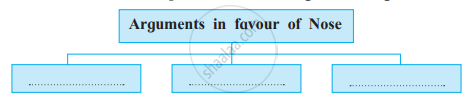
The tongue justifies the possession of the spectacles on behalf of the nose. Pick up the expressions from the poem that argues in favour of the Nose and complete the following web diagram.
Expand the idea inherent in the following proverb :
Fools rush in where angels fear to tread - Alexander Pope.
Say WHY. . . . . .
Ramanujan had to be hospitalized.
The whole world is happy because children are going to school. Why is it so? Discuss it in the classroom.
Complete the following sentence using your own ideas.
The princess was as ______ as ______. (Positive)
Visit a library:
This story is a fable. Find two more fables. Share them with your friends.
What can you do to show your love, respect, and support to the soldiers who fight for the country? Discuss this in the classroom. You can send greeting cards to them on various occasions, with the help of your teacher.
Comment on the given statement after reading the given dialogue -
And if we get him itself, nothing but abuse on our heads for it from the people, and maybe from our own relations -
you may begin like this
We do not think about society at large _________________________________________________.
Discuss the following question after you have seen a presentation of the ‘ad’.
What would happen if you ate proper meals like rice and dal or dal-roti?
Complete the following sentence with reference to the passage:
To this day, we venerate this tree as ____________.
Imagine that there is a Mr Somebody who has to correct all the wrongs that are done by Mr Nobody. Write in the following table, what Mr Somebody will have to do.
| Mr Nobody’s Actions | Tasks for Mr Somebody |
| 1. The plate is broken / cracked | Mend the plate. / Throw it away carefully. |
| 2. The book is torn | ____________ |
| 3. The door is ajar. | ____________ |
| 4. The buttons are pulled from the shirt | ____________ |
| 5. The pins are scattered. | ____________ |
| 6. The door is still squeaking. | ____________ |
| 7. There are finger marks upon the door. | ____________ |
| 8. The ink has spilled over. | ____________ |
| 9. Boots are lying around. | ____________ |
| 10. ____________ | ____________ |
| 11. ____________ | ____________ |
Add a few more things to the list in the above table, using your own ideas and experience.
Find the pairs of rhyming words used at the end of the lines in the poem.
Find out the following with the help of your teacher and the internet.
Seasonal Rains (monsoon) in India and other countries.
Prepare similar word chains using the following ideas.
sunshine - warm ________________.
Read the following from the Language Study pages:
- adjective clause
- adverb clause
- noun clause
Find one example of each from the passages. (Note the linking word when you do that.)
Write the symbol that is used in the poem to represent the following idea.
Choice of two options.
Find out how the following game is played.
Badminton
When do the parents feel sorry and become unhappy?
Why does the poet say that the dewdrops greet the dawn?
How did the bird try to reach its parents without having to fly?
Rearrange the following sentences in a coherent order.
- He ordered Ariel to torment the inmates of the ship.
- Miranda was attracted by Ferdinand and had more concern towards him.
- Prospero and Miranda came to an island and lived in a cave.
- Prospero forgave them and restored his dukedom, Milan.
- He raised a violent storm in the sea to wreck the ship of his enemies.
- Prospero wanted to test Ferdinand and gave a severe task to perform.
- Using his powers, Prospero released the good spirits from large bodies of trees.
- The King of Naples, and Antonio the false brother, repented the injustice they had done to Prospero.
- Ariel was instructed to bring Ferdinand, the prince of Naples to his cave.
- Ferdinand was the second human whom Miranda had seen after her father
How were offerings carried during the ancient period?
Hamid’s friends enjoyed the ride in the merry-go-round. But Hamid didn’t go on it. Why?
What scared Usha during the dark rainy night?
Fill in the blank
______ is the festival which fills our hearts with delight.
Why does Alice drink from the bottle that says ‘DRINK ME’ and why does she eat from the cake that says ‘EAT ME’?
Vasantha could not see the rescue operation because ______
Read the incidents. Work in small groups to role play the situations in which they showed their presence of mind. Each group should perform the skit for the rest of the class. Share similar situations in the class.
Selvi asked, 'Did they come in an aeroplane?' because she______.
Who came to India from Portugal in search of pepper?
What did Anandhan want to become?
When did the battle of Nauranang start? How long did it continue?
How was he honoured by the Indian government?
Vicky pleaded his father to buy a robot.
The hen-pigeon returned home when it started to _______.
Choose the correct answer.

Circle and write the adverbs.
I drink coffee thrice a day. ______
What are things that we can save? Why should we save them?
What did Rani want to become?
What will help you say the truth?
In memory of his mother, he carved ______ statue.
Which problem do you think you can solve with art? How?
We ______ yarn to make sarees.
Match the words with similar meaning.
| truck | subway |
| underground | lorry |
| tap | wallet |
| purse | faucet |
Who was burning with curiosity?
What is the poem about?
Who agreed to help Helen?
How does Tagore acknowledge Gandhi’s noble work?
Read the passage given below:
| 1. | Very often, we do not take the first step towards a good cause because we say to ourselves, "The task is so big. What can I do alone?" So nothing gets done. There is much talk about environmental protection, air pollution and saving our forests. Do we really care? If we do, here are a few things we can do to make our surroundings more pleasant. |
| 2. | It is good to adopt a two-uses-attitude! By putting an article to a second use, we are giving it a longer lease of life and using up less raw material from nature. One of the worst things we do is abuse of paper. The clean sides of envelopes can be used to write small notes, lists and reminders around the house. The more paper we use, the more trees will have to be cut down. For the same reason, we should avoid the use of paper napkins or paper plates. Cloth napkins are just as good, for they can be washed and used over and over again. |
| 3. | Another area which needs the most urgent attention is effective garbage disposal. People who are conscious about it follow rules and laws strictly. As a result, their neighbourhoods are clean and beautiful Similarly, each one of us can contribute to a cleaner environment. All kitchen waste should be collected separately. Those of you who have green fingers can turn this into valuable manure. Dig a pit and put the kitchen waste into it. When the pit is a little over half full, cover it up with mud. Let nature do the rest. Within three or six months, we will have a good garden manure. It can also be done as a community project by digging a large pit in the colony. Do take help of all the members, for nothing succeeds like co-operation |
| 4. | A lot of people don't care about the environment because they don't understand the adverse effect that society has on it. It is important to convince people to care about the environment. The first step would be to convince people to change by providing simple alternative solutions and ways of doing things. Theintemet is a powerful tool and a group on social media of like-minded people can be formed. People can share environmental stories and issues, as well as pool in solutions and alternatives to educate one another. With the current state that our planet is in, it is imperative that people actively care about the environment and most importantly to act now. |
Based on your understanding of the passage, answer any Eight questions from the nine given below:
- Why don't we take the first step towards a good cause?
- What is a two-uses-attitude?
- What can we do to avoid the abuse of paper? (any two points)
- What is the result of an effective way of a garbage disposal?
- What procedure can one adopt for kitchen waste?
- How can making of garden manure be done as community project?
- How long does it take to make good garden manure?
- Select a suitable word from the passage which means - being concerned or interested. (Paragraph 3)
- Pick out the word from the passage which means - completely necessary? (Paragraph 4)
