Advertisements
Advertisements
प्रश्न
Read the set of line from the poem and answer the question that follow.
… I mete and dole
Unequal laws unto a savage race,
That hoard, and sleep, and feed, and
know not me.
- What does Ulysses do?
- Did he enjoy what he was doing? Give reasons.
Advertisements
उत्तर
- Ulysses, like a grocery shop owner, measures and delivers rewards and punishments to a large number of uncivilized citizens.
- No, he did not enjoy his work. He does not like the idea of ministering variable justice to people who like “drones” or animals just eat, sleep and multiply their kind. He wants to leave such work to his son.
APPEARS IN
संबंधित प्रश्न
Did the soldiers fight with the enemies face to face?
Our gates were strong, our walls were thick,
Our only enemy was gold
Underline the alliterated word in the following line.
With our arms and provender, load on load.
Underline the alliterated word in the following line.
A little wicked wicket gate.
Underline the alliterated word in the following line.
The wizened warder let them through.
Identify the figure of speech used in the following line.
A little wicked wicket gate.
Can you call ‘The Castle’ an allegorical poem? Discuss.
What is the creeper compared to?
How does the creeper appear on the tree?
The casuarina tree will be remembered forever. Why?
Explain the following line with reference to the context.
It is the tree’s lament, an eerie speech,…
Fill in the blanks using the words given in the box to complete the summary of the poem.
Shakespeare considers the whole world a stage where men and women are only (1) ______. They (2)______the stage when they are born and exit when they die. Every man, during his life time, plays seven roles based on age. In the first act, as an infant, he is wholly (3) ______on the mother or a nurse. Later, emerging as a school child, he slings his bag over his shoulder and creeps most (4)______ to school. His next act is that of a lover, busy (5) ______ballads for his beloved and yearns for her (6) ______. In the fourth stage, he is aggressive and ambitious and seeks (7) ______in all that he does. He (8) ______solemnly to guard his country and becomes a soldier. As he grows older, with (9) ______and wisdom, he becomes a fair judge. During this stage, he is firm and (10) ______. In the sixth act, he is seen with loose pantaloons and spectacles. His manly voice changes into a childish (11) ______. The last scene of all is his second childhood. Slowly, he loses his (12) ______of sight, hearing, smell and taste and exits from the roles of his life.
| attention | treble | reluctantly |
| actors | maturity | reputation |
| serious | faculties | composing |
| enter | promises | dependent |
Explain the following line briefly with reference to the context.
“Jealous in honour, sudden and quick in quarrel,
Seeking the bubble reputation”.“They have their exits and their entrances;
Complete the table based on your understanding of the poem.
| Stage | Characteristic |
| crying | |
| judge | |
| soldier | |
| unhappy | |
| second childhood | |
| whining | |
| old man |
Introduction
The poem ‘Ulysses’ is a dramatic monologue that contains 70 lines of blank verse. Ulysses, the King of Ithaca, gathers his men together to prepare for the journey and exhorts them not to waste their time left on earth. Ulysses has grown old, having experienced many adventures at the battle of Troy and in the seas. After returning to Ithaca, he desires to embark upon his next voyage. His inquisitive spirit is always looking forward to more and more of such adventures.
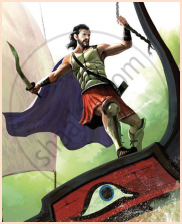
Complete the summary of the poem, choosing words from the list given below. Lines 44 to 70
Ulysses beckons his sailors to (1) ______at the port where the ship is ready to sail. His companions who have faced both (2) ______and sunshine with a smile, are united by their undying spirit of adventure. Though death would end everything, Ulysses urges his companions to join him and sail beyond the sunset and seek a newer (3) ______, regardless of consequences. These brave hearts who had once moved (4) ______ and earth, may have grown old and weak physically but their spirit is young and (5) ______. His call is an inspiration for all those who seek true knowledge and strive to lead (6) ______ lives.
| world, thunder, meaningful, gather, undaunted, heaven |
In what ways were Ulysses and his mariners alike?
Identify the figure of speech employed in the following line.
Thro’ scudding drifts the rainy Hyades Vext the dim sea...
Identify the figure of speech employed in the following line.
And drunk delight of battle with my peers;
What is Ulysses’ clarion call to his sailors? How does he inspire them?
The poet says
‘Without rich wanting nothing arrives’ but he condemns ‘the quest of lucre beyond a few easy needs.’ Analyse the difference and write.
Here are a few poetic device used in the poem.
Repetition- It is a figure of speech.
Read the line given below and answer the question that follow.
“Life is a soft loam; be gentle; go easy.” And this too might serve him.
- Why does the poet suggest to take life easy?
- Identify the figure of speech in the above line.
Read the line given below and answer the question that follow.
Tell him time as a stuff can be wasted.
Tell him to be a fool every so often
- Why does the poet suggest that time can be wasted?
- Identify the figure of speech in the above line.
Read the line given below and answer the question that follow.
..........Free imaginations
Bringing changes into a world resenting change.
- How does free imagination help the world?
- Identify the figure of speech.
Explain how the poet guides his son who is at the threshold of manhood, to face the challenges of life.
How according to the poet is it possible for his son to bring changes into a world that resents change?
What does the phrase ‘full galloping’ suggest?
Literary Devices
Mark the rhyme scheme of the poem. The rhyme scheme for the first stanza is as follows.
| With neck out-thrust, you fancy how, | a |
| Legs wide, arms locked behind, | b |
| As if to balance the prone brow | a |
| Oppressive with its mind. | b |
