Advertisements
Advertisements
प्रश्न
Read the line given below and answer the question that follow.
‘You’re wounded!’ ‘Nay’, his soldier’s pride Touched to the quick, he said:
- Why did the boy contradict Napoleon’s words?
- Why was his pride touched?
Advertisements
उत्तर
- The boy felt proud to die for his own country. So he contradicted Napoleon’s words by saying that he was killed and not wounded.
- His pride was touched quickly. He took pride and declared that he felt joy and thrill in giving his life for his own country.
APPEARS IN
संबंधित प्रश्न
Why were the soldiers in the castle fearless?
Our captain was brave and we were true
To whom does Toru Dutt want to consecrate the tree’s memory?
Explain the following line with reference to the context.
It is the tree’s lament, an eerie speech,…
Identify the figure of speech used in each of the extract given below and write down the answer in the space given below.
“ LIKE a huge Python, winding round and round
The rugged trunk indented deep with scars”,
Identify the figure of speech used in each of the extract given below and write down the answer in the space given below.
“ A creeper climbs, in whose embraces bound
No other tree could live. But gallantly
The giant wears the scarf, and flowers are hung......”
Describe the reminiscences of the poet, when she sees the casuarina tree.
What is the first stage of a human’s life?
Explain the following line briefly with reference to the context.
“Jealous in honour, sudden and quick in quarrel,
Seeking the bubble reputation”.“They have their exits and their entrances;
Explain the following line briefly with reference to the context.
“Is second childishness and mere oblivion;
Sans teeth, sans eyes, sans taste, sans everything.”
Pick out the word in ‘alliteration’ in the following line.
“Jealous in honour, sudden and quick in quarrel.”
Shakespeare has skilfully brought out the parallels between the life of man and actors on stage. Elaborate this statement with reference to the poem.
Introduction
The poem ‘Ulysses’ is a dramatic monologue that contains 70 lines of blank verse. Ulysses, the King of Ithaca, gathers his men together to prepare for the journey and exhorts them not to waste their time left on earth. Ulysses has grown old, having experienced many adventures at the battle of Troy and in the seas. After returning to Ithaca, he desires to embark upon his next voyage. His inquisitive spirit is always looking forward to more and more of such adventures.
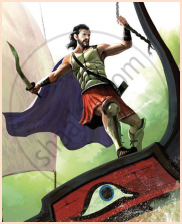
What does he think of the people of his kingdom?
Read the set of line from the poem and answer the question that follow.
This is my son, mine own Telemachus,
To whom I leave the sceptre and the isle Well-loved of me,
- Who does Ulysses entrust his kingdom to, in his absence?
- Bring out the significance of the ‘sceptre’.
Read the set of line from the poem and answer the question that follow.
That ever with a frolic welcome took
The thunder and the sunshine, and opposed
- What do ‘thunder’ and ‘sunshine’ refer to?
- What do we infer about the attitude of the sailors?
Explain with reference to the context the following line.
How dull it is to pause, to make an end,
To rust unburnished, not to shine in use!
How would the poet’s advice help his son who is at the threshold of the manhood?
The poet says
‘Without rich wanting nothing arrives’ but he condemns ‘the quest of lucre beyond a few easy needs.’ Analyse the difference and write.
Read the line given below and answer the question that follow.
“Life is a soft loam; be gentle; go easy.” And this too might serve him.
- Why does the poet suggest to take life easy?
- Identify the figure of speech in the above line.
Explain the following line with reference to the context.
Yet learning something out of every folly
hoping to repeat none of the cheap follies
Where was the narrator when the incident happened?
Who took the city of Ratisbon by storm?
Where did the rider plant the French flag after Ratisbon was captured?
Why did Napoleon’s eyes become soft as a mother eagle’s eyes?
Read the line given below and answer the question that follow.
A film the mother eagles eye When her bruised eaglet breathes
- Who is compared to the mother eagle in the above lines?
- Explain the comparison.
Explain the following line with reference to the context.
Then off there flung in smiling joy, And held himself erect
What is the role of the young soldier in the victory of the French at Ratisbon?
