Advertisements
Advertisements
प्रश्न
Explain the following line with reference to the context.
‘I’m killed, Sire!’ And, his Chief beside, Smiling, the boy fell dead.
Advertisements
उत्तर
- Reference:
These lines are taken from Poem – “Incident of the French Camp”, Poet – “Robert Browning”. - Context:
The poet appreciated the heroic behavior of the young soldier. - Explanation:
Napoleon became very happy about his victory, But suddenly he realized that the soldier was seriously wounded. He asked the soldier if he was wounded. The soldier replied that he was almost killed. Saying this he fell beside the emperor and died smilingly.
APPEARS IN
संबंधित प्रश्न
What thoughts come to your mind when you think about a castle? Add your ideas to the list
moat, huge buildings, soldiers, weapons ______,______.
How long had the soldiers been in the castle?
Why were the soldiers in the castle fearless?
What was the ‘shameful act’?
Read the given line and answer the question that follow in a line or two.
All through the summer at ease we lay,
And daily from the turret wall
We watched the mowers in the hay
- Who does ‘we’ refer to?
- How did the soldiers spend the summer days?
- What could they watch from the turret wall?
They seemed no threat to us at all.
How can this shameful tale be told?
Can you call ‘The Castle’ an allegorical poem? Discuss.
What is the creeper compared to?
How does the creeper appear on the tree?
Read the line given below and answer the question that follow.
The giant wears the scarf, and flowers are hung
In crimson clusters all the bough among!
- Who is the giant here?
- Why is the scarf colourful?
Identify the figure of speech used in each of the extract given below and write down the answer in the space given below.
“ A creeper climbs, in whose embraces bound
No other tree could live. But gallantly
The giant wears the scarf, and flowers are hung......”
Identify the figure of speech used in each of the extract given below and write down the answer in the space given below.
“ What is that dirge-like murmur that I hear Like the sea breaking on a shingle -beach?
Discuss with your partner the different stages in the growth of man from a new born to an adult

How does a man play a lover’s role?
Explain the following line briefly with reference to the context.
“They have their exits and their entrances;
And one man in his time plays many parts,”
Pick out the word in ‘alliteration’ in the following line.
“And one man in his time plays many parts”
Read the given line and answer the question that follow.
Then a soldier,
full of strange oaths, and bearded like the pard,
Jealous in honour, sudden and quick in quarrel,
Seeking the bubble reputation
Even in the cannon's mouth.
- What is the soldier ready to do?
- Explain ‘bubble reputation’.
- What are the distinguishing features of this stage?
Complete the table based on your understanding of the poem.
| Stage | Characteristic |
| crying | |
| judge | |
| soldier | |
| unhappy | |
| second childhood | |
| whining | |
| old man |
Describe the various stages of a man’s life picturised in the poem “All the World’s a stage."
Shakespeare has skilfully brought out the parallels between the life of man and actors on stage. Elaborate this statement with reference to the poem.
Introduction
The poem ‘Ulysses’ is a dramatic monologue that contains 70 lines of blank verse. Ulysses, the King of Ithaca, gathers his men together to prepare for the journey and exhorts them not to waste their time left on earth. Ulysses has grown old, having experienced many adventures at the battle of Troy and in the seas. After returning to Ithaca, he desires to embark upon his next voyage. His inquisitive spirit is always looking forward to more and more of such adventures.
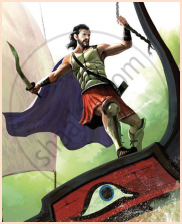
‘As tho’ to breathe were life!’ – From the given line what do you understand of Ulysses’ attitude to life?
Identify the figure of speech employed in the following line.
Thro’ scudding drifts the rainy Hyades Vext the dim sea...
Explain with reference to the context the following line.
I am become a name; For always roaming with a hungry heart
Explain with reference to the context the following line.
....you and I are old;
Old age hath yet his honour and his toil;
List the roles and responsibilities Ulysses assigns to his son Telemachus, while he is away.
Read the line given below and answer the question that follow.
“Life is a soft loam; be gentle; go easy.” And this too might serve him.
- Why does the poet suggest to take life easy?
- Identify the figure of speech in the above line.
Who came galloping on a horse to Napoleon?
Where did the rider plant the French flag after Ratisbon was captured?
