Advertisements
Advertisements
प्रश्न
Explain the following, giving two examples:
Heteroleptic
Explain a heteroleptic complex with an example.
Explain with two examples of the following:
Heteroleptic
Advertisements
उत्तर
Heteroleptic refers to a coordination complex where the central metal ion is coordinated with more than one type of ligand. For example:
- [CuCl4(NH3)2]2−: In this complex, copper (Cu2+) is coordinated with both chloride (Cl−) and ammonia (NH3) ligands, making it a heteroleptic complex.
- [Cr(H2O)4Cl2]+: In this complex, chromium (Cr3+) is coordinated with four water (H2O) molecules and two chloride (Cl−) ions, which also makes it heteroleptic.
APPEARS IN
संबंधित प्रश्न
Explain the following, giving two examples:
Coordination entity
What is meant by unidentate ligand?
Give the oxidation state, d-orbital occupation and coordination number of the central metal ion in the following complex:
[Mn(H2O)6]SO4
Amongst the following, the most stable complex is:
Which of the following compounds is used as a semipermeable membrane?
(a) Potassium ferrocyanide
(b) Potassium argentocyanide
(c) Sodium meta aluminate
(d) Copper ferrocyanide
Predict the co-ordination No. of cs+ ion if `r_(Cs)^+` = 1.69Å and `r_(Cl)^-` = 1.81Å.
IUPAC name of the following compound is
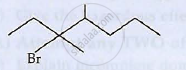
(a) 3 - Bromo- 3, 4- dimethylheptane
(b) 3, 4- dimethyl - 3- bromoheptane
(c) 5- Bromo- 4, 5- dimethylheptane
(d) 4, 5- dimethyl- 5- bromoheptane
Write IUPAC names of the following compounds

Write the IUPAC name of the following complex:
[Co(NH3)5(CO3)]Cl
Complete the following reactions
NH3+3Cl2(excess) ---->
Write the structures of compounds A, B and C in the following reactions

Write the IUPAC name of the following coordination compound:
[Cr(NH3)4(H2O)2]Cl3
Write the IUPAC name of the following coordination compound:
[PtCl2(NH3)4][PtCl4]
Write structures of compounds A and B of the following reaction :

Write structures of compounds A and B of the following reaction :

A group of atoms can function as a ligand only when:
The coordination number of Cr in [Cr(NH3)3(H2O)3]Cl3 is ___________.
What is the coordination number of chromium in \[\ce{[Cr(NH3)2(H2O2)2]Cl3}\]?
Which of the following is non-ionizable?
Which of the following complexes formed by \[\ce{Cu^2+}\] ions is most stable?
When 1 mol \[\ce{CrCl3.6H2O}\] is treated with excess of \[\ce{AgNO3}\], 3 mol of \[\ce{AgCl}\] are obtained. The formula of the complex is ______.
The correct \[\ce{IUPAC}\] name of \[\ce{[Pt(NH3)2Cl2]}\] is ______.
Which of the following complexes are heteroleptic?
(i) \[\ce{[Cr(NH3)6]^{3+}}\]
(ii) \[\ce{[Fe(NH3)4]Cl2]^+}\]
(iii) \[\ce{[Mn(CN)6]^{4-}}\]
(iv) \[\ce{[Co(NH3)4]Cl2]}\]
Identify the correct statements for the behaviour of ethane-1, 2-diamine as a ligand.
(i) It is a neutral ligand.
(ii) It is a didentate ligand.
(iii) It is a chelating ligand.
(iv) It is a unidentate ligand.
Match the complex ions given in Column I with the colours given in Column II and assign the correct code:
| Column I (Complex ion) | Column II (Colour) |
| A. \[\ce{[Co(NH3)6]^{3+}}\] | 1. Violet |
| B. \[\ce{[Ti(H2O)6]^{3+}}\] | 2. Green |
| C. \[\ce{[Ni(H2O)6]^{2+}}\] | 3. Pale blue |
| D. \[\ce{(Ni(H2O)4 (en)]^{2+} (aq)}\] | 4. Yellowish orange |
| 5. Blue |
What is the relationship between observed colour of the complex and the wavelength of light absorbed by the complex?
Oxidation number of carbon in CH2Cl2 is
In which of the following compounds, the oxidation number of iodine is fractional?
Which of the following is an ionic ligand?
The oxidation state of Fe in the brown ring complex [F3(H2O)5NO]SO4 is
Which one of the following ligands forms a chelate?
According to IUPAC nomenclatures, sodium nitroprusside is named as
Metal attached with EDTA in an octahedral complex, has coordination number ______.
The following ligand is:

The correct order of the spin-only magnetic moment of metal ions in the following low spin complexes,
\[\ce{[V(CN)6]^{4-}, [Fe(CN)6]^{4-}, [Ru(NH3)6]^{3+} and [Cr(NH3)6]^2}\] is:
Glycinato ligand is ______.
Is the central metal atom in coordination complexes a Lewis acid or a Lewis base? Explain.
What is meant by the chelate effect? Give an example.
In the complex ion \[\ce{[CoCl(en)2ONO]+}\], the coordination number and the oxidation number of the central metal ion are ______ and ______.
Explain with two examples of the following:
Ligand
Statement I: [Co(NH3)6]3+ is a homoleptic compleх whereas [Co(NH3)4Cl2]+ is a heteroleptic complex.
Statement II: Complex [Co(NH3)6]3+ has only one kind of ligands but [Co(NH3)4Cl2]+ has more than one kind of ligands.
In the light of the above statements, Choose the correct answer form the options given below.
