Advertisements
Advertisements
प्रश्न
Which of the following complexes formed by \[\ce{Cu^2+}\] ions is most stable?
पर्याय
\[\ce{Cu^{2+} + 4NH3 ⇌ [Cu(NH3)4]^{2+}, logK = 11.6}\]
\[\ce{Cu^{2+} + 4CN^- ⇌ [Cu(CN)4]^{2-}, logK = 27.3}\]
\[\ce{Cu^{2+} + 2en ⇌ [Cu(en)2]^{2+}, logK = 15.4}\]
\[\ce{Cu^{2+} + 4H2O ⇌ [Cu(H2O)4]^{2+}, logK = 8.9}\]
Advertisements
उत्तर
\[\ce{Cu^{2+} + 4CN^- ⇌ [Cu(CN)4]^{2-}, logK = 27.3}\]
Explanation:
The greater the value of log K, the greater will be stability of complex compound formed.
For reaction,
\[\ce{Cu^{2+} + 4CN^{-} -> [Cu(CN)4]^{2-}}\]
`"K" = (["Cu"(("CN")_4)^(2-)])/(["Cu"^(2+)]["CN"^(-)]^4)` and log K = 27.3
For this reaction, log K has highest value among the given four reactions. Hence, K will also be higher among these four, i.e., stability of the complexes will be highest among these four complexes.
APPEARS IN
संबंधित प्रश्न
IUPAC name of the following compound is
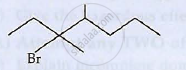
(a) 3 - Bromo- 3, 4- dimethylheptane
(b) 3, 4- dimethyl - 3- bromoheptane
(c) 5- Bromo- 4, 5- dimethylheptane
(d) 4, 5- dimethyl- 5- bromoheptane
What happens when PCl5 is heated? Write the equations involved.
Following compounds are given to you :
2-Bromopentane, 2-Bromo-2-methylbutane, 1-Bromopentane
1) Write the compound which is most reactive towards SN2 reaction.
2) Write the compound which is optically active.
3) Write the compound which is most reactive towards β-elimination reaction.
Write the IUPAC name of the following coordination compound:
[PtCl2(NH3)4][PtCl4]
In which of the following compounds the oxidation state of the nickel atom is 0?
Which of the following is non-ionizable?
In which of the following compounds, the Central metal atom/ion is in the lowest oxidation state?
When 0.1 mol \[\ce{CoCl3 (NH3)5}\] is treated with excess of \[\ce{AgNO3}\], 0.2 mol of \[\ce{AgCl}\] are obtained. The conductivity of solution will correspond to ______.
When 1 mol \[\ce{CrCl3.6H2O}\] is treated with excess of \[\ce{AgNO3}\], 3 mol of \[\ce{AgCl}\] are obtained. The formula of the complex is ______.
The stabilisation of coordination compounds due to chelation is called the chelate effect. Which of the following is the most stable complex species?
Which of the following complexes are heteroleptic?
(i) \[\ce{[Cr(NH3)6]^{3+}}\]
(ii) \[\ce{[Fe(NH3)4]Cl2]^+}\]
(iii) \[\ce{[Mn(CN)6]^{4-}}\]
(iv) \[\ce{[Co(NH3)4]Cl2]}\]
Identify the correct statements for the behaviour of ethane-1, 2-diamine as a ligand.
(i) It is a neutral ligand.
(ii) It is a didentate ligand.
(iii) It is a chelating ligand.
(iv) It is a unidentate ligand.
Oxidation number of cobalt in K[Co(CO)4] is
Which one of the following ligands forms a chelate?
According to IUPAC nomenclatures, sodium nitroprusside is named as
Metal attached with EDTA in an octahedral complex, has coordination number ______.
Which of the following species cannot act as a ligand? Give reason.
Assertion (A): EDTA is a hexadentate ligand.
Reason (R): EDTA has 2 nitrogen and 4 oxygen donor atoms.
In the complex ion \[\ce{[CoCl(en)2ONO]+}\], the coordination number and the oxidation number of the central metal ion are ______ and ______.
What is meant by ambidentate ligand?
