Advertisements
Advertisements
प्रश्न
Write structures of compounds A and B of the following reaction :

आकृती
Advertisements
उत्तर
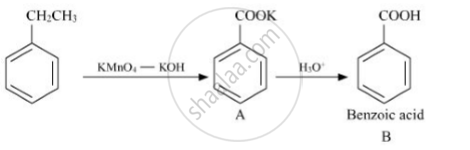
shaalaa.com
या प्रश्नात किंवा उत्तरात काही त्रुटी आहे का?
APPEARS IN
संबंधित प्रश्न
What is meant by unidentate ligand?
Write IUPAC names of the following compounds:

How is Benzonitrile converted to Benzophenone?
Ligand (en) is an example of ___________.
What is the coordination number of chromium in \[\ce{[Cr(NH3)2(H2O2)2]Cl3}\]?
Which one of the following does not achieve an octet of electrons in the central atom?
Why chelate complexes are more stable than complexes with unidentate ligands?
The following ligand is:

What is meant by the chelate effect? Give an example.
Homoleptic complex from the following complex is ____.
