Advertisements
Advertisements
प्रश्न
IUPAC name of the following compound is
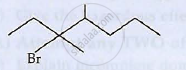
(a) 3 - Bromo- 3, 4- dimethylheptane
(b) 3, 4- dimethyl - 3- bromoheptane
(c) 5- Bromo- 4, 5- dimethylheptane
(d) 4, 5- dimethyl- 5- bromoheptane
Advertisements
उत्तर
3-Bromo-3,4-dimethylheptane
APPEARS IN
संबंधित प्रश्न
Give the oxidation state, d-orbital occupation and coordination number of the central metal ion in the following complex:
cis-[CrCl2(en)2]Cl
Give the oxidation state, d-orbital occupation and coordination number of the central metal ion in the following complex:
(NH4)2[CoF4]
How is Benzonitrile converted to Benzophenone?
Complete the following reactions
NH3+3Cl2(excess) ---->
Write structures of compounds A and B of the following reaction :

A group of atoms can function as a ligand only when:
The coordination number of the central ion may be obtained from:
Which of the following complexes formed by \[\ce{Cu^2+}\] ions is most stable?
A complex of the type \[\ce{[M(AA)2X2]^{n+}}\] is known to be optically active. What does this indicate about the structure of the complex? Give one example of such complex.
Match the compounds given in Column I with the oxidation state of cobalt present in it (given in Column II) and assign the correct code:
| Column I (Compound) | Column II (Oxidation state of Co) |
| A. \[\ce{[Co(NCS)(NH3)5](SO3)}\] | 1. + 4 |
| B. \[\ce{[Co(NH3)4 CL2]SO4}\] | 2. 0 |
| C. \[\ce{Na4[Co(S2O3)3]}\] | 3. + 1 |
| D. \[\ce{[Co2(CO)8]}\] | 4. + 2 |
| 5. + 3 |
Oxidation number of cobalt in K[Co(CO)4] is
The nature of hybridisation in the ammonia molecule is
The oxidation state of Fe in the brown ring complex [F3(H2O)5NO]SO4 is
The co-ordinate number and the oxidation state of the element E in the complex [E(en)2(C2O4)]NO2 are respectively?
Which of the following ligands can exhibit linkage isomerism?
Ethylene diamine tetraacetate (EDTA) ion is ______.
What are Homoleptic complexes?
How many ions are produced from the complex Co(NH3)6]Cl2 in solution?
The following ligand is:

Assertion (A): EDTA is a hexadentate ligand.
Reason (R): EDTA has 2 nitrogen and 4 oxygen donor atoms.
Does ionization isomer for the following compound exist? Justify your answer.
\[\ce{Hg[Co(SCN)4]}\]
Is the central metal atom in coordination complexes a Lewis acid or a Lewis base? Explain.
Explain the following, giving two examples:
Homoleptic
What is meant by a didentate ligand?
Give two examples of didentate ligands.
Homoleptic complex from the following complex is ____.
