Advertisements
Advertisements
प्रश्न
Explain the following, giving two examples:
Coordination entity
Explain with two examples of the following:
Coordination entity
Advertisements
उत्तर
A coordination entity constitutes a central metal atom or ion bonded to a fixed number of ions or molecules. For example, [CoCl3(NH3)3] is a coordination entity in which the cobalt ion is surrounded by three ammonia molecules and three chloride ions. Other examples are [Ni(CO)4], [PtCl2(NH3)2], [Fe(CN)6]4−, [Co(NH3)6]3+.
APPEARS IN
संबंधित प्रश्न
Give the oxidation state, d-orbital occupation and coordination number of the central metal ion in the following complex:
[Mn(H2O)6]SO4
IUPAC name of the following compound is
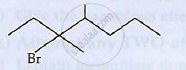
(a) 3 - Bromo- 3, 4- dimethylheptane
(b) 3, 4- dimethyl - 3- bromoheptane
(c) 5- Bromo- 4, 5- dimethylheptane
(d) 4, 5- dimethyl- 5- bromoheptane
Write applications of co-ordination compounds in medicine and electroplating.
The ligand triethylenetetramine is _______.
Ligand (en) is an example of ___________.
The coordination number of the central ion may be obtained from:
What is the coordination number of chromium in \[\ce{[Cr(NH3)2(H2O2)2]Cl3}\]?
The stabilisation of coordination compounds due to chelation is called the chelate effect. Which of the following is the most stable complex species?
Which of the following complexes are homoleptic?
(i) \[\ce{[Co(NH3)6]^{3+}}\]
(ii) \[\ce{[Co(NH3)4 Cl2]^{+}}\]
(iii) \[\ce{[Ni(CN)4]^{2-}}\]
(iv) \[\ce{[Ni(NH3)4Cl2]}\]
Match the coordination compounds given in Column I with the central metal atoms given in Column II and assign the correct code:
| Column I (Coordination Compound) | Column II (Central metal atom) |
| A. Chlorophyll | 1. rhodium |
| B. Blood pigment | 2. cobalt |
| C. Wilkinson catalyst | 3. calcium |
| D. Vitamin B12 | 4. iron |
| 5. magnesium |
Oxidation number of cobalt in K[Co(CO)4] is
The nature of hybridisation in the ammonia molecule is
Oxidation number of carbon in CH2Cl2 is
The oxidation state of Fe in the brown ring complex [F3(H2O)5NO]SO4 is
What are Homoleptic complexes?
What is meant by the chelate effect? Give an example.
Explain the following, giving two examples:
Homoleptic
What is meant by ambidentate ligand?
Statement I: [Co(NH3)6]3+ is a homoleptic compleх whereas [Co(NH3)4Cl2]+ is a heteroleptic complex.
Statement II: Complex [Co(NH3)6]3+ has only one kind of ligands but [Co(NH3)4Cl2]+ has more than one kind of ligands.
In the light of the above statements, Choose the correct answer form the options given below.
