Advertisements
Advertisements
प्रश्न
Explain the following, giving two examples:
Coordination entity
Explain with two examples of the following:
Coordination entity
Advertisements
उत्तर
A coordination entity constitutes a central metal atom or ion bonded to a fixed number of ions or molecules. For example, [CoCl3(NH3)3] is a coordination entity in which the cobalt ion is surrounded by three ammonia molecules and three chloride ions. Other examples are [Ni(CO)4], [PtCl2(NH3)2], [Fe(CN)6]4−, [Co(NH3)6]3+.
APPEARS IN
संबंधित प्रश्न
Predict the co-ordination No. of cs+ ion if `r_(Cs)^+` = 1.69Å and `r_(Cl)^-` = 1.81Å.
IUPAC name of the following compound is
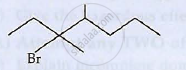
(a) 3 - Bromo- 3, 4- dimethylheptane
(b) 3, 4- dimethyl - 3- bromoheptane
(c) 5- Bromo- 4, 5- dimethylheptane
(d) 4, 5- dimethyl- 5- bromoheptane
How is Benzonitrile converted to Benzophenone?
What happens when PCl5 is heated? Write the equations involved.
Write the structures of compounds A, B and C in the following reactions:

A group of atoms can function as a ligand only when:
The coordination number of the central ion may be obtained from:
In which of the following compounds the oxidation state of the nickel atom is 0?
What is the coordination number of chromium in \[\ce{[Cr(NH3)2(H2O2)2]Cl3}\]?
Which of the following complexes formed by \[\ce{Cu^2+}\] ions is most stable?
Match the coordination compounds given in Column I with the central metal atoms given in Column II and assign the correct code:
| Column I (Coordination Compound) | Column II (Central metal atom) |
| A. Chlorophyll | 1. rhodium |
| B. Blood pigment | 2. cobalt |
| C. Wilkinson catalyst | 3. calcium |
| D. Vitamin B12 | 4. iron |
| 5. magnesium |
What is the relationship between observed colour of the complex and the wavelength of light absorbed by the complex?
The oxidation state of Fe in the brown ring complex [F3(H2O)5NO]SO4 is
Which one of the following ligands forms a chelate?
The correct order of the spin-only magnetic moment of metal ions in the following low spin complexes,
\[\ce{[V(CN)6]^{4-}, [Fe(CN)6]^{4-}, [Ru(NH3)6]^{3+} and [Cr(NH3)6]^2}\] is:
Glycinato ligand is ______.
Assertion (A): EDTA is a hexadentate ligand.
Reason (R): EDTA has 2 nitrogen and 4 oxygen donor atoms.
Explain the following, giving two examples:
Coordination polyhedron
Explain the following, giving two examples:
Homoleptic
Homoleptic complex from the following complex is ____.
