Advertisements
Advertisements
प्रश्न
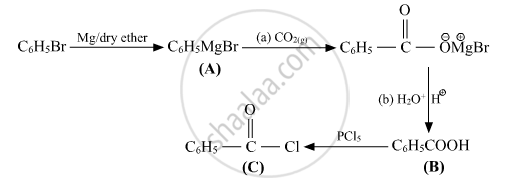
Write structures of compounds A, B and C in of the following reactions

Advertisements
उत्तर
shaalaa.com
क्या इस प्रश्न या उत्तर में कोई त्रुटि है?
APPEARS IN
संबंधित प्रश्न
Write the structure and IUPAC names of all the metamers represented by formula C4H10
Write structures of compounds A, B and C in of the following reactions

Write the structures of compounds A, B and C in the following reactions

The ligand triethylenetetramine is _______.
Which of the following complexes are homoleptic?
(i) \[\ce{[Co(NH3)6]^{3+}}\]
(ii) \[\ce{[Co(NH3)4 Cl2]^{+}}\]
(iii) \[\ce{[Ni(CN)4]^{2-}}\]
(iv) \[\ce{[Ni(NH3)4Cl2]}\]
Which one of the following does not achieve an octet of electrons in the central atom?
Oxidation number of carbon in CH2Cl2 is
Which one of the following ligands forms a chelate?
The most stable ion is ______.
What are Heteroleptic complexes?
