Advertisements
Advertisements
प्रश्न
The correct \[\ce{IUPAC}\] name of \[\ce{[Pt(NH3)2Cl2]}\] is ______.
विकल्प
Diamminedichloridoplatinum (II)
Diamminedichloridoplatinum (IV)
Diamminedichloridoplatinum (0)
Dichloridodiammineplatinum (IV)
Advertisements
उत्तर
The correct \[\ce{IUPAC}\] name of \[\ce{[Pt(NH3)2Cl2]}\] is Diamminedichloridoplatinum (II).
Explanation:
The complex compound is \[\ce{[Pt(NH3)2Cl2]}\].
\[\ce{NH3}\] is a neutral ligand and named as amine.
\[\ce{Cl}\] is anion ligand and named as chloride. Di or Tri is prefixed to represent the number.
APPEARS IN
संबंधित प्रश्न
What is meant by unidentate ligand?
IUPAC name of the following compound is
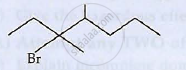
(a) 3 - Bromo- 3, 4- dimethylheptane
(b) 3, 4- dimethyl - 3- bromoheptane
(c) 5- Bromo- 4, 5- dimethylheptane
(d) 4, 5- dimethyl- 5- bromoheptane
Write structures of compounds A, B and C in of the following reactions

Following compounds are given to you :
2-Bromopentane, 2-Bromo-2-methylbutane, 1-Bromopentane
1) Write the compound which is most reactive towards SN2 reaction.
2) Write the compound which is optically active.
3) Write the compound which is most reactive towards β-elimination reaction.
Write IUPAC name of the following Complex [Cr(NH3)3Cl3]
Write the IUPAC name of the following complex:
[Co(NH3)5(CO3)]Cl
The ligand triethylenetetramine is _______.
In which of the following compounds, the Central metal atom/ion is in the lowest oxidation state?
Which of the following complexes formed by \[\ce{Cu^2+}\] ions is most stable?
Which of the following complexes are homoleptic?
(i) \[\ce{[Co(NH3)6]^{3+}}\]
(ii) \[\ce{[Co(NH3)4 Cl2]^{+}}\]
(iii) \[\ce{[Ni(CN)4]^{2-}}\]
(iv) \[\ce{[Ni(NH3)4Cl2]}\]
Assertion: \[\ce{Cr(H2O)6]Cl2 and [Fe(H2O)6]Cl2}\] are reducing in nature.
Reason: Unpaired electrons are present in their d-orbitals.
The co-ordinate number and the oxidation state of the element E in the complex [E(en)2(C2O4)]NO2 are respectively?
Metal attached with EDTA in an octahedral complex, has coordination number ______.
Given below are two statements.
Statement I: In CuSO4·5H2O, Cu-O bonds are present.
Statement II: In CuSO4·5H2O, ligands coordinating with Cu(II) ion are O- and S-based ligands.
In light of the above statement, choose the correct answer from the options given below.
The following ligand is:

Does ionization isomer for the following compound exist? Justify your answer.
\[\ce{Hg[Co(SCN)4]}\]
What is meant by the chelate effect? Give an example.
Explain with two examples of the following:
Ligand
Statement I: [Co(NH3)6]3+ is a homoleptic compleх whereas [Co(NH3)4Cl2]+ is a heteroleptic complex.
Statement II: Complex [Co(NH3)6]3+ has only one kind of ligands but [Co(NH3)4Cl2]+ has more than one kind of ligands.
In the light of the above statements, Choose the correct answer form the options given below.
Homoleptic complex from the following complex is ____.
