Advertisements
Advertisements
Question
Which of the following complexes formed by \[\ce{Cu^2+}\] ions is most stable?
Options
\[\ce{Cu^{2+} + 4NH3 ⇌ [Cu(NH3)4]^{2+}, logK = 11.6}\]
\[\ce{Cu^{2+} + 4CN^- ⇌ [Cu(CN)4]^{2-}, logK = 27.3}\]
\[\ce{Cu^{2+} + 2en ⇌ [Cu(en)2]^{2+}, logK = 15.4}\]
\[\ce{Cu^{2+} + 4H2O ⇌ [Cu(H2O)4]^{2+}, logK = 8.9}\]
Advertisements
Solution
\[\ce{Cu^{2+} + 4CN^- ⇌ [Cu(CN)4]^{2-}, logK = 27.3}\]
Explanation:
The greater the value of log K, the greater will be stability of complex compound formed.
For reaction,
\[\ce{Cu^{2+} + 4CN^{-} -> [Cu(CN)4]^{2-}}\]
`"K" = (["Cu"(("CN")_4)^(2-)])/(["Cu"^(2+)]["CN"^(-)]^4)` and log K = 27.3
For this reaction, log K has highest value among the given four reactions. Hence, K will also be higher among these four, i.e., stability of the complexes will be highest among these four complexes.
APPEARS IN
RELATED QUESTIONS
What is the coordination entity formed when excess of aqueous KCN is added to an aqueous solution of copper sulphate? Why is it that no precipitate of copper sulphide is obtained when H2S(g) is passed through this solution?
Give the oxidation state, d-orbital occupation and coordination number of the central metal ion in the following complex:
cis-[CrCl2(en)2]Cl
IUPAC name of the following compound is
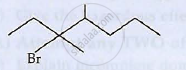
(a) 3 - Bromo- 3, 4- dimethylheptane
(b) 3, 4- dimethyl - 3- bromoheptane
(c) 5- Bromo- 4, 5- dimethylheptane
(d) 4, 5- dimethyl- 5- bromoheptane
How is Benzonitrile converted to Benzophenone?
Write structures of compounds A, B and C in of the following reactions

Write IUPAC name of the following Complex [Cr(NH3)3Cl3]
Complete the following reactions
NH3+3Cl2(excess) ---->
Which of the following is non-ionizable?
When 1 mol \[\ce{CrCl3.6H2O}\] is treated with excess of \[\ce{AgNO3}\], 3 mol of \[\ce{AgCl}\] are obtained. The formula of the complex is ______.
A coordination compound \[\ce{CrCl3.4H2O}\] precipitates silver chloride when treated with silver nitrate. The molar conductance of its solution corresponds to a total of two ions. Write structural formula of the compound and name it.
Oxidation number of cobalt in K[Co(CO)4] is
The oxidation state of Fe in the brown ring complex [F3(H2O)5NO]SO4 is
According to IUPAC nomenclatures, sodium nitroprusside is named as
Metal attached with EDTA in an octahedral complex, has coordination number ______.
What are Heteroleptic complexes?
The correct order of the spin-only magnetic moment of metal ions in the following low spin complexes,
\[\ce{[V(CN)6]^{4-}, [Fe(CN)6]^{4-}, [Ru(NH3)6]^{3+} and [Cr(NH3)6]^2}\] is:
Does ionization isomer for the following compound exist? Justify your answer.
\[\ce{Hg[Co(SCN)4]}\]
Is the central metal atom in coordination complexes a Lewis acid or a Lewis base? Explain.
Explain the following, giving two examples:
Heteroleptic
Give two examples of ambidentate ligands.
