Advertisements
Advertisements
Question
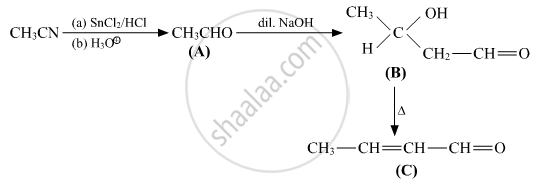
Write structures of compounds A, B and C in of the following reactions

Advertisements
Solution
APPEARS IN
RELATED QUESTIONS
Which of the following compounds is used as a semipermeable membrane?
(a) Potassium ferrocyanide
(b) Potassium argentocyanide
(c) Sodium meta aluminate
(d) Copper ferrocyanide
Write the IUPAC name of the following complex:
[Co(NH3)5(CO3)]Cl
Which of the following represents a chelate ligand?
In which of the following compounds, the Central metal atom/ion is in the lowest oxidation state?
The correct \[\ce{IUPAC}\] name of \[\ce{[Pt(NH3)2Cl2]}\] is ______.
A coordination compound \[\ce{CrCl3.4H2O}\] precipitates silver chloride when treated with silver nitrate. The molar conductance of its solution corresponds to a total of two ions. Write structural formula of the compound and name it.
What are Homoleptic complexes?
What is meant by the chelate effect? Give an example.
Explain with two examples of the following:
Ligand
What is meant by a didentate ligand?
