Advertisements
Advertisements
प्रश्न
Which of the following complexes formed by \[\ce{Cu^2+}\] ions is most stable?
विकल्प
\[\ce{Cu^{2+} + 4NH3 ⇌ [Cu(NH3)4]^{2+}, logK = 11.6}\]
\[\ce{Cu^{2+} + 4CN^- ⇌ [Cu(CN)4]^{2-}, logK = 27.3}\]
\[\ce{Cu^{2+} + 2en ⇌ [Cu(en)2]^{2+}, logK = 15.4}\]
\[\ce{Cu^{2+} + 4H2O ⇌ [Cu(H2O)4]^{2+}, logK = 8.9}\]
Advertisements
उत्तर
\[\ce{Cu^{2+} + 4CN^- ⇌ [Cu(CN)4]^{2-}, logK = 27.3}\]
Explanation:
The greater the value of log K, the greater will be stability of complex compound formed.
For reaction,
\[\ce{Cu^{2+} + 4CN^{-} -> [Cu(CN)4]^{2-}}\]
`"K" = (["Cu"(("CN")_4)^(2-)])/(["Cu"^(2+)]["CN"^(-)]^4)` and log K = 27.3
For this reaction, log K has highest value among the given four reactions. Hence, K will also be higher among these four, i.e., stability of the complexes will be highest among these four complexes.
APPEARS IN
संबंधित प्रश्न
Write the structure and IUPAC names of all the metamers represented by formula C4H10
Explain the following, giving two examples:
Coordination entity
What is the coordination entity formed when excess of aqueous KCN is added to an aqueous solution of copper sulphate? Why is it that no precipitate of copper sulphide is obtained when H2S(g) is passed through this solution?
Predict the co-ordination No. of cs+ ion if `r_(Cs)^+` = 1.69Å and `r_(Cl)^-` = 1.81Å.
IUPAC name of the following compound is
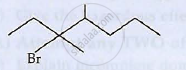
(a) 3 - Bromo- 3, 4- dimethylheptane
(b) 3, 4- dimethyl - 3- bromoheptane
(c) 5- Bromo- 4, 5- dimethylheptane
(d) 4, 5- dimethyl- 5- bromoheptane
Write structures of compounds A, B and C in of the following reactions

Following compounds are given to you :
2-Bromopentane, 2-Bromo-2-methylbutane, 1-Bromopentane
1) Write the compound which is most reactive towards SN2 reaction.
2) Write the compound which is optically active.
3) Write the compound which is most reactive towards β-elimination reaction.
Write structures of compounds A and B of the following reaction :

When 0.1 mol \[\ce{CoCl3 (NH3)5}\] is treated with excess of \[\ce{AgNO3}\], 0.2 mol of \[\ce{AgCl}\] are obtained. The conductivity of solution will correspond to ______.
When 1 mol \[\ce{CrCl3.6H2O}\] is treated with excess of \[\ce{AgNO3}\], 3 mol of \[\ce{AgCl}\] are obtained. The formula of the complex is ______.
Arrange the following complexes in the increasing order of conductivity of their solution:
[Co(NH3)3Cl3], [Co(NH3)4Cl2]Cl, [Co(NH3)6]Cl3, [Cr(NH3)5Cl]Cl2
Oxidation number of carbon in CH2Cl2 is
The oxidation state of Fe in the brown ring complex [F3(H2O)5NO]SO4 is
The following ligand is:

Which of the following species cannot act as a ligand? Give reason.
What is meant by the chelate effect? Give an example.
Explain the following, giving two examples:
Coordination number
Homoleptic complex from the following complex is ____.
