Advertisements
Advertisements
प्रश्न
Which of the following complexes are heteroleptic?
(i) \[\ce{[Cr(NH3)6]^{3+}}\]
(ii) \[\ce{[Fe(NH3)4]Cl2]^+}\]
(iii) \[\ce{[Mn(CN)6]^{4-}}\]
(iv) \[\ce{[Co(NH3)4]Cl2]}\]
Advertisements
उत्तर
(ii) \[\ce{[Fe(NH3)4]Cl2]^+}\]
(iv) \[\ce{[Co(NH3)4]Cl2]}\]
Explanation:
Complexes in which a metal is bound to more than one kind of donor groups are known as heteroleptic. This condition is satisfied by complexes mentioned at \[\ce{[Cr(NH3)6]^{3+}}\] and \[\ce{[Co(NH3)4]Cl2]}\] where the donor groups are \[\ce{NH3}\] and \[\ce{Cl2}\].
APPEARS IN
संबंधित प्रश्न
Write the structure and IUPAC names of all the metamers represented by formula C4H10
Give the oxidation state, d-orbital occupation and coordination number of the central metal ion in the following complex:
[Mn(H2O)6]SO4
IUPAC name of the following compound is
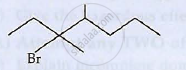
(a) 3 - Bromo- 3, 4- dimethylheptane
(b) 3, 4- dimethyl - 3- bromoheptane
(c) 5- Bromo- 4, 5- dimethylheptane
(d) 4, 5- dimethyl- 5- bromoheptane
Write IUPAC names of the following compounds

What happens when PCl5 is heated? Write the equations involved.
Write structures of compounds A, B and C in of the following reactions

Write structures of compounds A, B and C in of the following reactions

The ligand triethylenetetramine is _______.
Which of the following is non-ionizable?
When 1 mol \[\ce{CrCl3.6H2O}\] is treated with excess of \[\ce{AgNO3}\], 3 mol of \[\ce{AgCl}\] are obtained. The formula of the complex is ______.
In which of the following compounds, the oxidation number of iodine is fractional?
The oxidation number d-arbitral occupation and co-ordination number of Cr in the complex cis [Cr(en)2Cl2]Cl are respectively.
Why chelate complexes are more stable than complexes with unidentate ligands?
The correct order of the spin-only magnetic moment of metal ions in the following low spin complexes,
\[\ce{[V(CN)6]^{4-}, [Fe(CN)6]^{4-}, [Ru(NH3)6]^{3+} and [Cr(NH3)6]^2}\] is:
Glycinato ligand is ______.
The one that will show optical activity is: (en = ethane 1, 2-diamine)
What is meant by the chelate effect? Give an example.
Give two examples of ambidentate ligands.
Statement I: [Co(NH3)6]3+ is a homoleptic compleх whereas [Co(NH3)4Cl2]+ is a heteroleptic complex.
Statement II: Complex [Co(NH3)6]3+ has only one kind of ligands but [Co(NH3)4Cl2]+ has more than one kind of ligands.
In the light of the above statements, Choose the correct answer form the options given below.
