Advertisements
Advertisements
प्रश्न
Both a wine maker and a molecular biologist who had developed a recombinant vaccine claim to be biotechnologists. Who in your opinion is correct?
A wine maker and a molecular biologist who has developed a recombinant vaccine, both claim themselves to be biotechnologist. Who in your opinion is right?
Advertisements
उत्तर
Both. As biotechnology is a very wide area that deals with techniques of using a ‘natural’ organism (or its parts) as well as genetically modified organisms to produce products and processes useful for mankind. A winemaker employs a strain of yeast to produce wine by fermentation (a natural phenomenon), while the molecular biologist has cloned the gene for the antigen (that is used as a vaccine) in an organism, which allows the production of the antigen in large amounts.
संबंधित प्रश्न
Rearrange the following in the correct sequence to accomplish an important biological reaction:
(a) In vitro synthesis of copies of DNA of interest
(b) Chemically synthesized oligonucleotides
(c) Enzyme DNA-polymerase
(d) Complementary region of DNA
(e) Genomic DNA template
(f) Nucleotides provided
(g) Primers
(h) Thermostable DNA-polymerase (from Thermus aquaticus)
(i) Denaturation of ds-DNA
What would be the molar concentration of human DNA in a human cell?
Name the most commonly used bioreactor and describe its working.
Write a short note on Electrophoresis.
The bacterium which causes a plant disease called crown gall is _______________.
Enlist different types of restriction enzymes commonly used in rDNA technology? Write about their role.
ECoRI is obtained from ______.
What is gene cloning? Explain different tools used for it.
From the following list of cloning vectors used in rDNA technology identify the vectors that are the most commonly used.
Plasmids, bacteriophages (Ml3, lambda virus), cosmid, phagemid, BAC (bacterial artificial chromosome), YAC (yeast artificial chromosome), transposons, baculoviruses, and mammalian artificial chromosomes (MACs)
Which of the following is TRUE regarding EcoR I?
Identify the characters that a cloning vector should possess.
i. Origin of replication (Ori)
ii. Ability to destroy the alien DNA
ii. Cloning site to link the alien DNA
iv. The tumour inducing plasmid Ti
v. Selectable marker
vi. Low molecular weight
The time taken to complete one cycle of PCR is around ______.
In which of the following techniques, charged molecules (DNA, RNA and Proteins) are separated by applying the electric field?
Study the following statements regarding separation of DNA using agarose gel electrophoresis.
- Large fragments of DNA molecules move faster than small DNA fragments and thus separate faster.
- DNA being negatively charged migrates to cathode.
Name and describe the technique that helps in separation of DNA fragments.
A hind of biotechnology involving manipulation of DNA is ______.
DNA fingerprinting refers to ______.
Name the plant disease caused by Agrobacterium tumefaciens.
Which of the following is the correct recognition sequence of restriction enzyme Eco RI?
Which of the following enzyme catalyses the removal of nucleotides from the end of DNA molecules?
The given figure is the diagrammatic representation of the E. coli vector pBR322. Which one of the given options correctly indentites its certain component(s)?
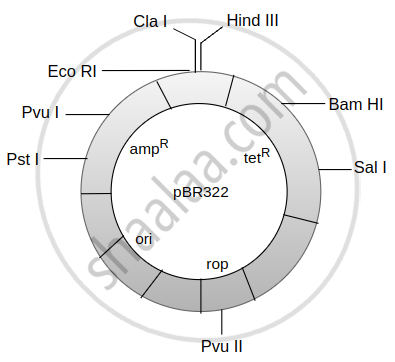
Study the following lists and choose the correct match.
| List I | List II |
| A. Vector | (i) Resistant to cotton bollworms |
| B. Downstream processing | (ii) Mobile genetic elements |
| C. Cry II AB | (iii) Controls corn borers |
| D. Transposons | (iv) Ti plasmid |
| (v) Purifying protein in biopharmaceuticals |
pBR322, used very frequently in cloning experiments as a vector in E. coli is ______.
Write a short note on vectors.
Explain the mechanism of PCR.
Name the source of thermostable DNA polymerase.
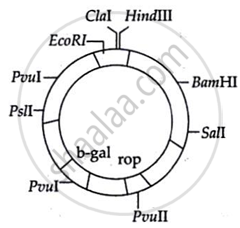
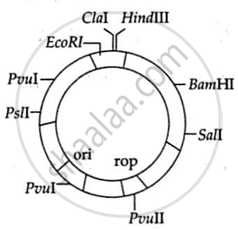
Suneeta is planning an experiment to clone a gene in a vector. So, she has to choose a good cloning vector.
Which one of the vectors shown below should she choose? Justify your answer by giving two reasons.
 |
 |
 |
| Vector A | Vector B | Vector C |
Restriction enzymes are referred to as 'molecular scissors' because they:
The origin of replication is best described as:
