Advertisements
Advertisements
प्रश्न
Name and describe the technique that helps in separation of DNA fragments.
Advertisements
उत्तर
The fragments can be separated by a technique called gel electrophoresis.
Steps are as follows:
- Step: 1. The DNA fragments are loaded on a gel or matrix and an electric current is applied. The most commonly used matrix is agarose which is a natural polymer extracted from seaweeds.
- Step: 2. Since DNA fragments are negatively charged they move towards the positive charge i.e. anode under an electric field through a gel.
- Step: 3. The DNA fragments move through the gel and separate according to their size. The bigger ones move slowly and the smaller ones move faster.
- Step: 4. The separated fragments can be visualized after staining the DNA with Ethidium bromide followed by exposure to UV radiation. The DNA fragments can be seen as bright orange coloured bands in UV light.
- Step: 5. The separated bands are cut from the agarose gel and extracted from the gel piece.
- Step: 6. DNA fragments purified in this way are used for constructing rDNA after joining them with cloning vectors.
APPEARS IN
संबंधित प्रश्न
State the role of DNA ligase in biotechnology.
Define vector? write any two examples,
For which of the following reason Agrobacterium tumefaciens is most widely used for gene transfer in plants?
Identify the process by which bacteria protect their own DNA from the attack of restriction enzymes.
What would happen when one grows a recombinant bacterium in a bioreactor but forget to add antibiotic to the medium in which the recombinant is growing?
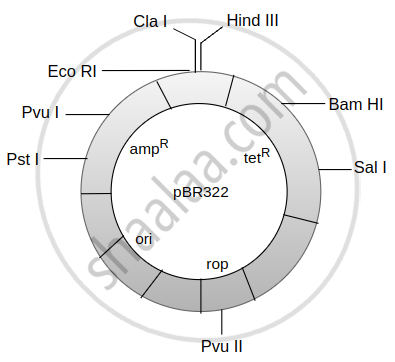
The given figure is the diagrammatic representation of the E. coli vector pBR322. Which one of the given options correctly indentites its certain component(s)?
Name the enzyme responsible for the transcription of genetic code to produce mRNA.
Which one of the following enzymes is used to join DNA fragments?
Modern biotechnology is based on two core techniques. Which of the following correctly identifies both of these techniques?
What is the relationship between alien DNA and the origin of replication in the concept of cloning?
