Advertisements
Advertisements
प्रश्न
Answer the following question.
a) What is meant by corrosion?
b) Write names of any two methods of prevention of corrosion.
c) In which method, metal like copper, aluminium are coated with a thin layer of their oxides by means of electrolysis.
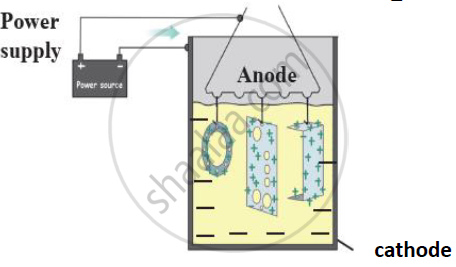
d) Explain this method with diagram.
Advertisements
उत्तर
a. corrosion: Corrosion is a process where the water or the moisture on the surface of the metal oxidizes with the atmospheric oxygen.
b. Methods of prevention (any two each carry 1/2 mark) 1
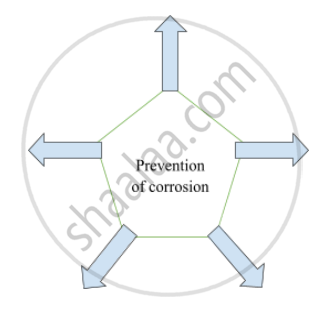
1. Galvanizing 2. Anodization 3. Tinning
4. Electroplating 5. Alloying
c. Anodization
d. In this process cupper, aluminum are coated with a thin layer of their oxides by means of electrolysis. For this copper or aluminum article is used as anode. It obstructs the contact of the aluminum or copper with oxygen and water.
APPEARS IN
संबंधित प्रश्न
Give two examples of alloys with their chemical composition.
Write two methods of preventing the rusting of iron.
Explain the term corrosion.
Two methods by which rusting of iron can be prevented are ______ and ______.
Explain why rusting of iron objects is faster in coastal areas than in deserts.
Choose the correct answer from the options given below:
Heating an ore in a limited supply of air or in the absence of air at a temperature just below its melting point is known as
A. Smelting
B. Ore-dressing
C. Calcination
D. Bessemerisation
Name any three objects (or structures) which are gradually damaged by the corrosion of iron and steel.
What is meant by galvanisation? Why is it done?
Name the metal which is used for galvanising iron.
State two conditions for the rusting of iron.
Tiffin boxes are electroplated with ______ but car bumpers are electroplated with ______ to protect them from rusting.
Why is an iron grill painted frequently?
Name two metals which resist corrosion due to the formation of a thin, hard and impervious layer of oxide on their surface.
What are the constituents of stainless steel?
Name a common metal which is highly resistant to corrosion.
A common metal which is highly resistant to corrosion is ______.
If copper is kept exposed to damp air for a considerable time, it gets a green coating on its surface. This is due to the formation of ______.
Four metals P, Q, R and S are all obtained by the reduction of their oxides with carbon. Metal P is used to form a thin layer over the sheets of metal S to prevent its corrosion. Metal Q is used for electroplating tiffin boxes made of metal S whereas metal R is used in making car batteries. Metals Q and R form an alloy called solder. What are metals P, Q, R and S? How have you arrived at this conclusion?
Bronze is an alloy of ______.
Name the metal which is a constituent of blood pigment?
What is corrosion? What are necessary conditions for corrosion?
State under what conditions corrosion is faster ?
What are the adverse effects of corrosion?
_______ is an alloy made from iron, carbon and chromium.
Which of the following method is used to prevent the accumulation of greenish layer on brass due to corrosion?
_______ forms a green colour in the water.
When one of the metals in an alloy is mercury the alloy is called _______.
Rusting of iron : Fe2O3 : : corrosion of copper : ______
Find the odd one out and give its explanation.
Complete flow chart given below.
Observe the following diagram and write answers.
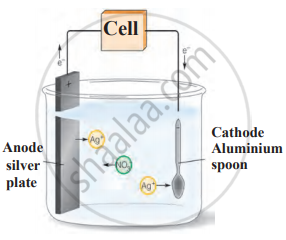
- Name the method.
- Explain the method.
- Give two examples of this method.
The table shown below gives information about four substances: A, B, C and D.
| SUBSTANCE | MELTING POINT (K) | ELECTRICAL CONDUCTIVITY | |
| SOLID | LIQUID/ AQUEOUS | ||
| A | 295 | Good | Good |
| B | 1210 | Poor | Good |
| C | 1890 | Poor | Good |
| D | 1160 | Poor | Poor |
Identify Ionic compounds from the above given substances.
Identify the correct statement from the following:
State whether the following statement is true or false:
Ships suffer a lot of damage though they are painted.
Give an example of a chemical reaction for the following situation:
Sound is produced
Explain the chemical reactions in rusting of iron.
