Advertisements
Advertisements
प्रश्न
Name a common metal which is highly resistant to corrosion.
Advertisements
उत्तर
Aluminium is a common metal that is highly resistant to corrosion because it is a highly reactive metal. It reacts easily with oxygen in air and forms a layer of aluminium oxide on its surface. This aluminium oxide layer is very tough and does not allow air to enter the metal for further reaction, thus preventing further corrosion of aluminium.
APPEARS IN
संबंधित प्रश्न
What is an alloy?
Give two examples of alloys with their chemical composition.
Write a chemical equation to show the process of corrosion of iron.
Fill in the following blank with suitable word:
The process of depositing a thin layer of zinc on iron articles is called .............
What is meant by 'rusting of iron'? With the help of labelled diagrams, describe an activity to find out the conditions under which iron rusts.
Name two metals which resist corrosion due to the formation of a thin, hard and impervious layer of oxide on their surface.
Explain why, when a copper object remains in damp air for a considerable time, a green coating is formed on its surface. What is this process known as?
A metal X which is resistant to corrosion is produced by the electrolysis of its molten oxide whereas another metal Y which is also resistant to corrosion is produced by the reduction of its oxide with carbon. Metal X can be used in powder form in thermite welding whereas metal Y is used in making cathodes of ordinary dry cells.
(a) Name the metals X and Y.
(b) Which of the two metals is more reactive : X or Y?
(c) Name one ore or metal X. Also write its chemical formula.
(d) Name one ore or metal Y. Also write its chemical formula.
(e) Name one alloy of metal X and one alloy of metal Y.
Bronze is an alloy of ______.
Compare roasting and calcination.
No chemical reaction takes place when granules of a solid, A, are mixed with the powder of another solid, B. However when the mixture is heated, a reaction takes place between its components. One of the products, C, is a metal and settles down in the molten state while the other product, D, floats over it. It was observed that the reaction is highly exothermic.
(i) Based on the given information make an assumption about A and B and write a chemical equation for the chemical reaction indicating the conditions of reaction, physical state of reactants and products and thermal status of reaction.
(ii) Mention any two types of reactions under which above chemical reaction can be classified.
Find the odd one out and give its explanation.
Find the odd one out and give its explanation.
Write the name.
Method used to prevent corrosion of copper.
Observe the following figure and write the answer of the question.
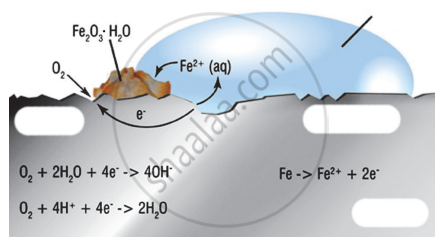
- Which process is shown in the figure?
- Explain the chemical reaction shown in the figure.
- Write the reactions on anode and cathode.
The diagram shows the reaction between metal and dil. acid.

What is the reason for different behaviour of Mg in test tube B?
Explain the following:
Bubbles are produced when acetic acid is added to a solution of sodium hydrogencarbonate.
Give an example of a chemical reaction for the following situation:
Sound is produced
In ______ process a layer of molten tin is deposited on metals.
