Advertisements
Advertisements
प्रश्न
Observe the following figure and write the answer of the question.
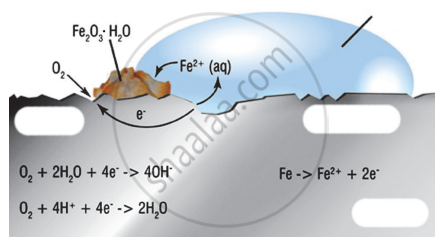
- Which process is shown in the figure?
- Explain the chemical reaction shown in the figure.
- Write the reactions on anode and cathode.
Advertisements
उत्तर
- The process shown in the figure is rusting (corrosion) of iron.
- The process involves electrochemical reaction. Different regions on the surface of iron become anode and cathode. In the anode region, Fe is oxidized to Fe2+. The electron released in the anode region flow through the metal surface to the cathode region where they reduce oxygen.
In the cathode region, O2 is reduced to form water. When Fe2+ ions migrate from the anode region, they react with water (or OH− ions) and further get oxidized to Fe3+ ions. Fe3+ ions form an insoluble hydrated oxide (Fe2O3.H2O), which is deposited as reddish-brown layer on the surface. It is called rust.
\[\ce{2F^3+_{(aq)} + 4H2O_{(l)} -> \underset{\text{Rust}}{Fe2O3.H2O_{(s)}} + 6H+_{(aq)}}\] - Anode region: \[\ce{Fe_{(s)} -> Fe^2+_{(aq)} + 2e^-}\]
Cathode region: \[\ce{O_{2(g)} + 4H^+_{(aq)} + 4e^- -> 2H2O_{(l)}}\]
APPEARS IN
संबंधित प्रश्न
Write two methods of preventing the rusting of iron.
What are alloys?
Give reasons:
Platinum, gold and silver are used to make jewellery.
Explain how painting of an iron gate prevents it from rusting.
Explain the term “corrosion” with an example. Write a chemical equation to show the process of corrosion of iron.
Name the metal which is used for galvanising iron.
State two conditions for the rusting of iron.
With the help of labelled diagrams, describe an activity to find out the conditions under which iron rusts.
What are the constituents of stainless steel?
Explain why, when a copper object remains in damp air for a considerable time, a green coating is formed on its surface. What is this process known as?
If copper is kept exposed to damp air for a considerable time, it gets a green coating on its surface. This is due to the formation of ______.
Brass is an alloy of ______.
Mention two uses of the following metals and non-metals
Iron
Corrosion can be an advantage in some case.Explain ?
Answer the following question.
a) What is meant by corrosion?
b) Write names of any two methods of prevention of corrosion.
c) In which method, metal like copper, aluminium are coated with a thin layer of their oxides by means of electrolysis.
d) Explain this method with diagram.
Find the odd man out:
Give reason.
An iron article should be given a coat of paint
Give reason.
A wooden article should be polished.
Explain the term – rusting and give a word equation for the formation of rust. If polished iron nails are kept in three separate test tubes, state the contents in each test tube required, to prove the conditions for rusting.
Give reason for the following:
A suspension of rust is basic in nature.
Write a short note on Alloying.
Observe the following picture and answer the following questions:
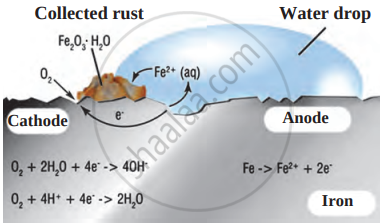
- What is rust?
- Write the chemical formula of rust.
- Write the reaction of oxidation of iron at the anode.
- Write the reaction of oxidation of iron at the cathode.
- What is corrosion?
Rusting of iron : Fe2O3 : : corrosion of copper : ______
Write the name.
An alloy of copper and tin-
Write scientific reason.
Anodization method is useful for prevention of the corrosion of the aluminium.
Write scientific reason.
On exposure to air, silver articles turn blackish after some time.
Write scientific reason.
Coins are made from metals and alloys.
Write a molecular formula for rust.
Observe the following diagram and give answers.
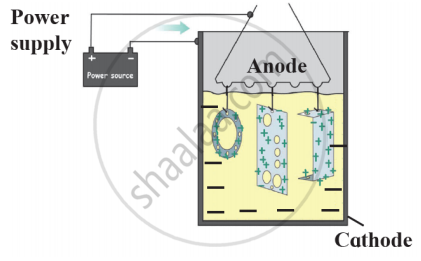
- Name this method of prevention of corrosion.
- For prevention of which metal this method is used?
- What is used as anode in this method?
The process of coating the surface of the metal with a thin layer of zinc is called ______
Copper objects lose their shine and form green coating of ____________.
Explain the following:
Lime water turns milky on passing carbon dioxide gas into it.
Give an example of a chemical reaction for the following situation:
Sound is produced
| A process of forming a thick oxide of aluminium when aluminium is exposed to air. This coat makes it resistant to corrosion. Resistance can be improved by making a layer of oxide thinker. In this technique, the aluminium article is the anode, and the electrolyte is sulphuric acid. The anode reaction results in the formation of a black-coloured film of aluminium oxide on the anode. By putting appropriate dyes in the electrolytic solution, both coloured surface with the decorative finish is achieved. Kitchen articles like anodised such as pressure cookers, pans and frames of sliding windows are applications of this technique. |
- Name the anode and electrolyte used in this technique.
- How can we make aluminium articles made resistant to corrosion?
- Name the technique used to coat the aluminium articles.
In ______ process a layer of molten tin is deposited on metals.
